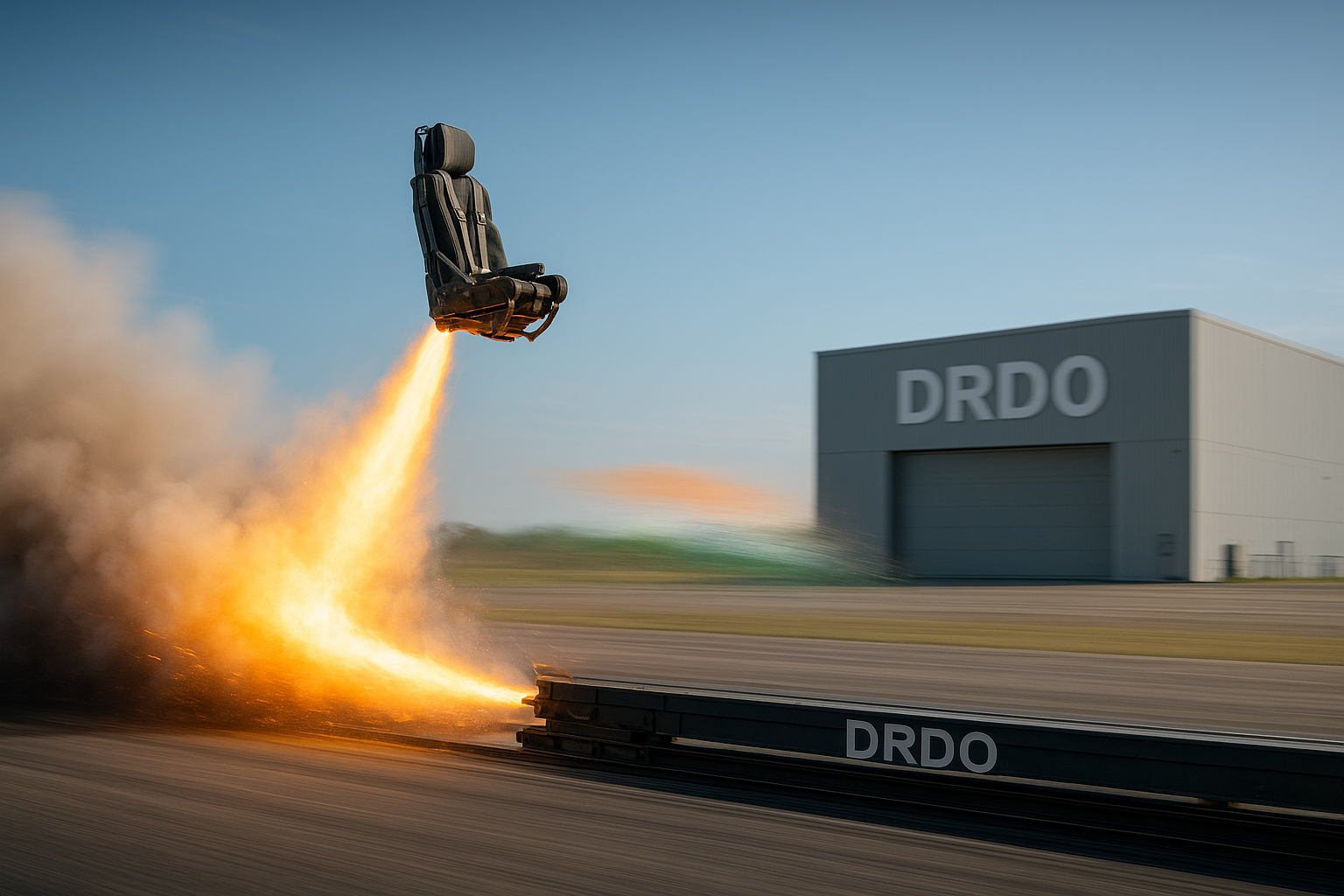
 India has taken another major step in advancing aviation safety technology. A recent video shared widely on social media shows the Defence Research and Development Organisation (DRDO) successfully conducting a high-speed rocket sled test for a fighter aircraft’s escape system.
This test has created buzz across defence circles, and for good reason. It highlights India’s growing capability in developing life-saving technologies for pilots who operate in extreme conditions.
What Was the High-Speed Rocket Sled Test?
The viral video shows a test conducted on a long rail track known as a rocket sled track.
DRDO mounted an ejection system on this track and propelled it at extremely high speed using rockets. The goal was to simulate real conditions that a fighter jet might face during a critical emergency.
This kind of test allows engineers to measure:
-
The stability of the seat
-
The reliability of the escape mechanism
-
The seat’s ability to safely eject a pilot under high-speed conditions
-
The durability of the parachute deployment system
Such tests are crucial before integrating the system into actual fighter jets.
What the Video Host Prashant Dhawan Explained
Defence analyst Prashant Dhawan, known for simplifying complex topics, released a detailed explanation of the test.
He clarified that many people misunderstood the video as an actual aircraft emergency or a failed flight attempt. It was not a fighter jet crash or a mid-air ejection.
Dhawan highlighted that this was a ground-based safety test, and such tests are regularly conducted to ensure full reliability of the escape system before it is used inside a cockpit.
He also explained why this test matters:
-
It helps verify pilot safety during high-G forces
-
Engineers can study how the seat behaves at different velocities
-
Data from these tests improves future fighter jet designs
-
It builds confidence in India’s indigenous aviation technologies
Why Ejection Seats Are So Critical in Fighter Jets
A fighter aircraft travels at extremely high speeds. Even a small mechanical failure, bird hit, or tactical threat can turn into a dangerous situation within seconds.
This is where the ejection seat system becomes a pilot’s final and most crucial safety mechanism.
A modern ejection seat is designed to:
-
Push the pilot out of the cockpit instantly
-
Deploy parachutes at the correct altitude
-
Stabilise the pilot’s landing
-
Work even at low altitude or zero speed
-
Save lives during uncontrolled aircraft behaviour
Prashant Dhawan emphasised that the system has proven itself in real incidents over the years. Many pilots—across different air forces—owe their lives to timely ejection.
Previous Incidents Proving the Importance of Ejection Systems
Dhawan mentioned a sensitive but important example from the past involving a Pakistani aircraft crash.
During that accident, the aircraft was destroyed, but the ejection system performed its job and saved the pilot’s life.
Such incidents show how vital and non-negotiable an ejection system is. Even the most advanced fighter jets like the Rafale, F-16, and Su-30 depend on these seats to protect pilots during emergencies.
Modern ejection seats are engineered to operate:
-
Under extreme temperatures
-
During engine explosions
-
In high-speed dives
-
In cases of fire or weapon malfunction
-
Even when the aircraft is inverted
India’s efforts to test these systems locally shows the nation’s commitment to strengthening pilot safety.
Why the DRDO Test Is Significant for India
The rocket sled test reflects India’s technological progress in several ways.
1. Indigenous Capability
Developing ejection systems in-house reduces dependence on foreign suppliers. This aligns perfectly with the ‘Make in India’ and Aatmanirbhar Bharat vision.
2. Better Pilot Safety
Indian Air Force pilots often fly in some of the toughest terrains—from deserts to mountains.
A perfect ejection system is essential to protect them during unforeseen failures.
3. Cost Savings
Importing ejection seats and related technology is expensive. Indigenisation helps reduce long-term defence costs.
4. Stronger Fighter Jet Programs
DRDO’s work directly supports major projects like:
-
Tejas Mk-1
-
Tejas Mk-2
-
AMCA (Advanced Medium Combat Aircraft)
-
Future unmanned combat aircraft
Reliable escape systems increase the overall safety rating of these jets.
Understanding How an Ejection Seat Works
Dhawan’s video also highlighted that many viewers are unaware of how ejection seats actually operate.
Here’s a simple breakdown:
Step 1: Pilot Pulls the Ejection Handle
This handle is usually between the pilot’s legs or on the side.
Step 2: Canopy Shatters or Blows Away
A small explosion or detonation cord removes the cockpit canopy.
Step 3: Rocket Motor Fires
The seat is pushed upward at lightning speed, sometimes up to 20G acceleration.
Step 4: Seat Stabilises Itself
Fins or small rockets orient the seat for proper posture.
Step 5: Parachute Opens
The system deploys the parachute at a safe altitude.
Step 6: Seat Separates
The pilot detaches from the seat and descends safely to the ground.
These steps happen in less than 2 seconds, showing how advanced the mechanism is.
Common Misconceptions Addressed by Dhawan
Prashant Dhawan pointed out several misconceptions that people have about ejection seats:
-
Misconception 1: Ejection is like jumping out of a plane.
→ Reality: It’s a complex explosive mechanism driven by rocket motors. -
Misconception 2: Ejection is always safe.
→ Reality: It is risky. Many pilots suffer back injuries despite landing safely. -
Misconception 3: Ejection is used casually.
→ Reality: Pilots use it only as a last resort. -
Misconception 4: The viral video showed an aircraft crash.
→ Reality: It was a controlled DRDO test, not an accident.
How This Test Helps India’s Defence Future
The successful test strengthens India’s confidence in deploying these systems across future jets. It provides engineers with:
-
Real-time acceleration data
-
Seat trajectory measurements
-
Parachute deployment accuracy
-
Pilot survival probability across conditions
This test also positions India as a country capable of designing and validating its own high-end aviation safety technology.
Public Reaction and Social Media Buzz
Once the video went viral, many social media users appreciated India’s progress.
Comments praised DRDO for conducting world-class tests and showed curiosity about how the system works.
However, some viewers misinterpreted the clip as a jet malfunction.
Prashant Dhawan’s explanation cleared the confusion and provided accurate context.
Conclusion: A Big Step for India’s Aviation Safety
The DRDO high-speed rocket sled test marks a major achievement in India’s defence technology journey.
It reflects the nation’s commitment to safeguarding its pilots and building cutting-edge indigenous systems.
Prashant Dhawan’s detailed explanation helped millions understand the purpose, importance, and science behind this critical test.
As India develops more advanced fighter jets, reliable ejection systems will remain a vital component of national air defence.
India is clearly moving toward a future where every part of its aircraft—from engines to safety systems—is proudly made and perfected at home.