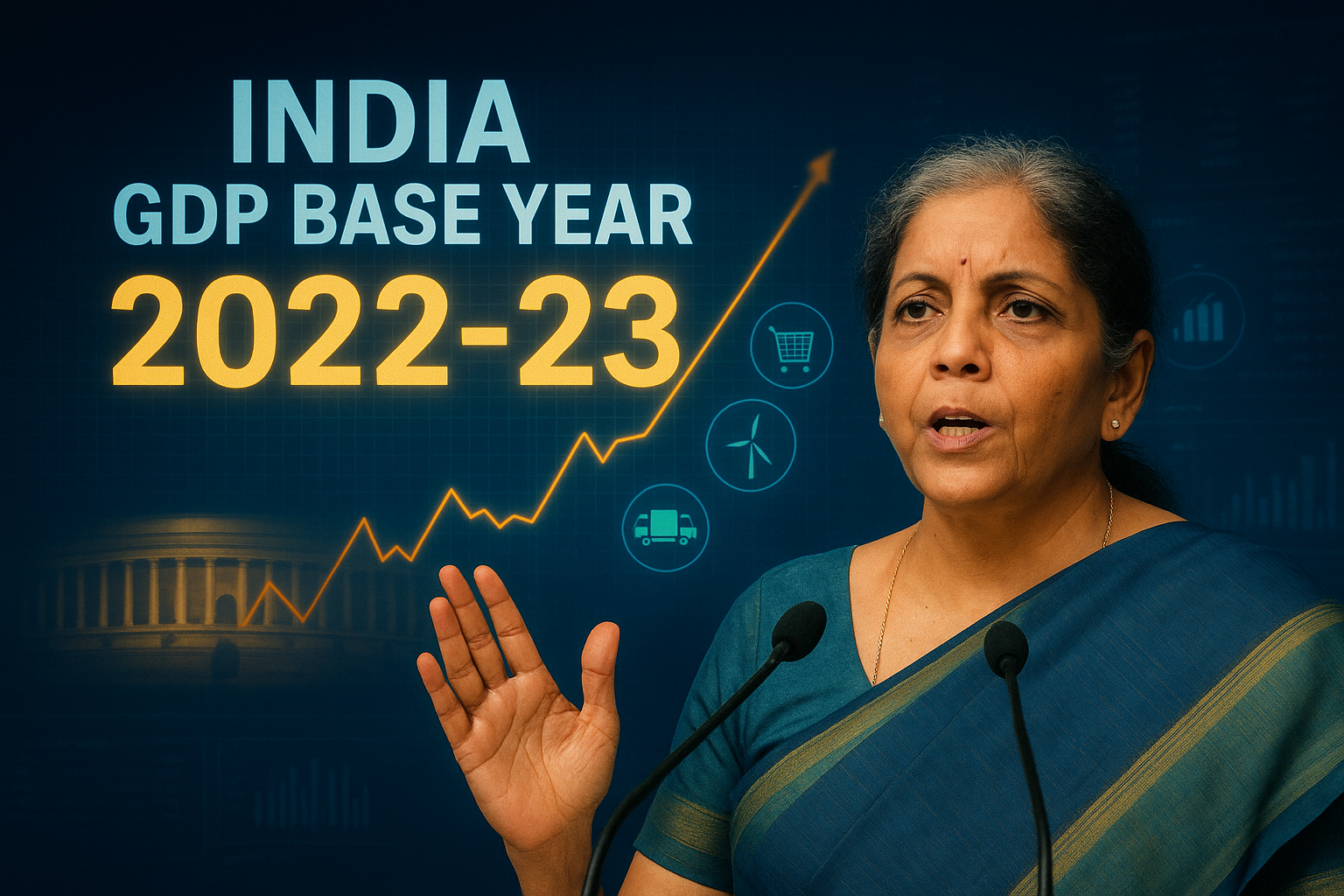
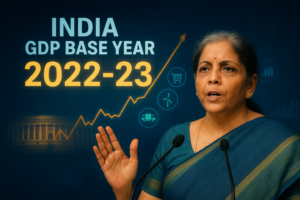
 The Indian government, led by Finance Minister Nirmala Sitharaman, has announced a major statistical reform: the GDP base year will be shifted from 2011-12 to 2022-23.
This update comes at a crucial time when questions were raised about the accuracy of GDP calculations, especially after the IMF gave India a C grade in its GDP measurement assessment.
In this article, we will break down what this change means, why it matters, and how it will impact India’s economy in the coming years.
What Is a GDP Base Year and Why Does It Matter?
To understand the change, it’s important to know what a base year is.
The GDP base year is the reference year used to calculate real GDP, which measures economic growth after removing inflation.
It provides a fixed price level, allowing economists to compare growth across different years accurately.
A base year must reflect:
-
The current structure of the economy
-
Latest consumption patterns
-
Updated business sectors
-
Technological advancements
Since economies evolve rapidly, base years must be updated every few years.
India last updated its base year in 2015, shifting from 2004-05 to 2011-12. More than a decade has passed, and the structure of India’s economy has changed massively since then.
Why Was There a Need to Change the Base Year?
The immediate trigger came from the International Monetary Fund (IMF).
The IMF recently rated India’s GDP calculation as C grade, signalling weaknesses in the outdated methodology and data sources.
Reasons for concern:
-
The 2011-12 base year no longer reflected today’s economic realities.
-
Rapid growth in digital payments, online commerce, AI, fintech, renewable energy was not fully captured.
-
Several new industries contributed significantly to GDP but were not adequately weighted.
-
Old price indices failed to capture inflation accurately.
The government’s decision aims to restore global confidence, improve data quality, and bring India’s GDP computation in line with modern economic methods.
Why Choose 2022-23 as the New Base Year?
The year 2022-23 is considered stable and suitable for becoming the new economic benchmark.
Here’s why:
-
It represents a post-pandemic economic recovery phase, avoiding distortions caused during COVID-19 years.
-
Economic activity normalised across sectors.
-
Digital sectors boomed during this period, making it the best representation of today’s economy.
-
India recorded strong growth, giving a clean and stable reference year for future comparisons.
Thus, choosing 2022-23 helps present a more realistic, updated, and accurate picture of India’s economic structure.
How Will the Base Year Shift Change GDP Numbers?
This is the biggest question everyone is asking.
GDP figures are likely to change once the new base year is implemented.
What may happen:
1. Revised Sectoral Weights
Sectors that were small in 2011-12 but huge today will get greater importance:
-
Digital commerce
-
UPI-based financial services
-
Start-up ecosystem
-
Renewable energy and green technology
-
Electric vehicle (EV) manufacturing
-
Logistics and warehousing
-
App economy and online services
This will make calculations more aligned with current realities.
2. GDP Growth Rate May Look Different
Growth rates for some years might be revised upward or downward.
For example:
-
Some years previously recorded as low growth may look better under the new structure.
-
Some sectors previously undervalued may show stronger performance.
-
Inflation adjustments will become more accurate with updated price indices.
3. Better Measurement of the Informal Sector
The informal sector contributes nearly 45% of India’s GDP, and its measurement has improved due to GST, digital payments, and formalisation.
The new base year will capture this more effectively.
Positive Impacts on the Indian Economy
The revision of the GDP base year is expected to bring several long-term benefits.
1. More Accurate Economic Planning
Governments depend on GDP data to design policies related to:
-
Fiscal planning
-
Budget allocation
-
Industrial policies
-
Infrastructure investment
-
Employment schemes
With updated numbers, policies become sharper and more effective.
2. Better Global Credibility
After the IMF’s C-grade assessment, the shift signals seriousness toward data transparency and global statistical standards.
It strengthens India’s credibility with:
-
International investors
-
Credit rating agencies
-
IMF and World Bank
-
Foreign governments
Better GDP accuracy means stronger confidence in India’s financial system.
3. Improved Investment Decisions
Investors—both domestic and foreign—rely heavily on GDP statistics.
An updated base year means:
-
Better sectoral insights
-
Improved understanding of new-age industries
-
Clearer growth patterns
This can lead to more FDI, stronger stock market performance, and a boost to start-ups.
4. More Clarity on Employment and Productivity
Many emerging sectors such as digital services, gig jobs, and renewable energy are major employers today.
The new base year will:
-
Reflect current employment trends
-
Show productivity improvements
-
Identify high-growth job-creating sectors
This helps the government plan job policies more effectively.
Challenges & Concerns With the Base Year Shift
While the overall move is positive, there are certain challenges:
1. Historical Comparisons Become Harder
When the base year changes, growth comparisons for older decades become less meaningful.
Economists will need to re-estimate long-term time series data.
2. Transition May Create Confusion
Businesses, analysts, and investors will need time to adjust to:
-
New methods
-
New price indices
-
Revised sector weightings
Initially, there may be confusion in interpreting GDP trends.
3. Possible Political Debates
Any change in GDP numbers can trigger:
-
Accusations of data manipulation
-
Political arguments about economic performance
-
Conflicting interpretations
Thus, communication from the government becomes important.
Which Sectors Will Gain More Importance in GDP?
Based on India’s evolving economy, several sectors will likely be given higher weight:
1. Digital Commerce & Fintech
-
UPI transactions
-
Online shopping
-
Digital banks and wallets
-
Startup-led services
India is now a global leader in digital payments, and GDP must reflect this.
2. Renewable Energy
-
Solar power
-
Wind energy
-
Green hydrogen
-
Battery storage
These sectors have grown rapidly since 2011-12.
3. Logistics & Warehousing
Driven by:
-
E-commerce boom
-
Dedicated freight corridors
-
GST-led supply chain improvements
4. Electronics & EV Manufacturing
India’s push for “Make in India” and EV adoption makes these sectors crucial in the revised GDP calculation.
What Does This Mean for India’s Future?
The base year shift to 2022-23 will give India a clearer, more transparent view of its economic performance.
Expected outcomes:
-
Stronger global trust
-
More accurate growth estimates
-
Better policy planning
-
A modernised view of India’s digital and green economy
-
Improved investor confidence
GDP numbers will no longer under-represent new-age industries, making India’s growth story more accurate and future-ready.
Conclusion
The decision to update India’s GDP base year from 2011-12 to 2022-23 is a much-needed reform.
It reflects how the Indian economy has transformed in the last decade—digitally, technologically, and structurally.
With better sectoral representation, improved data quality, and updated price indices, India will be able to present a realistic and credible GDP picture to the world.
This shift is not just a statistical change—it is a powerful step toward modernising India’s economic measurement system for the next decade.