
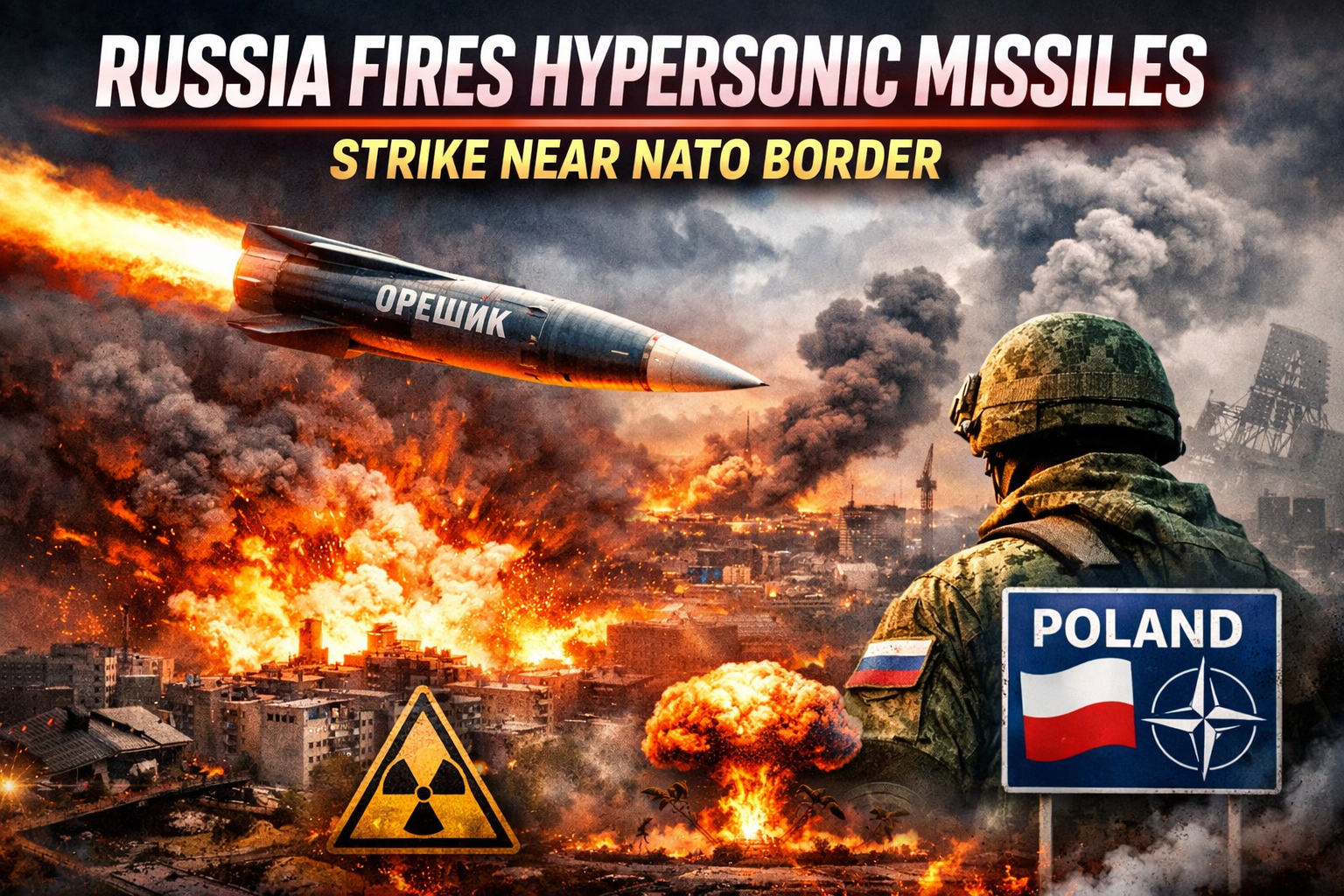
 Russia has sharply escalated the war in Ukraine by launching hypersonic missiles close to the NATO border, particularly near Poland. This move has raised serious concerns across Europe and among Western military alliances.
The attack signals a dangerous new phase in the conflict, with Russia showcasing advanced weapons that could alter the balance of modern warfare. Analysts view this strike as both a military action and a strategic warning to NATO countries.
Russia Escalates Military Operations Near NATO Territory
The latest missile strike targeted western Ukraine, a region strategically close to NATO member Poland. This proximity is alarming because any spillover could trigger a wider international conflict.
Russia’s choice of location appears deliberate. By striking near NATO borders, Moscow is testing Western resolve while stopping short of directly attacking alliance territory.
Military experts say this move is meant to intimidate NATO without crossing the line that would activate collective defense measures under Article 5.
Hypersonic Missile “Oreshik” Used in the Attack
Russia reportedly used a hypersonic missile known as “Oreshik” during the attack. This missile can travel at speeds exceeding Mach 10, which is more than ten times the speed of sound.
At such extreme speeds, traditional radar systems struggle to detect and track the missile in time. This gives defenders very little opportunity to respond.
The use of Oreshik marks a significant escalation, as hypersonic weapons are considered among the most advanced and dangerous in modern arsenals.
What Makes the Oreshik Missile So Dangerous?
The Oreshik missile is not just fast. It is also nuclear-capable, meaning it can carry either conventional or nuclear warheads.
This dual-use capability makes it particularly threatening. Even if launched with a conventional payload, its nuclear potential sends a powerful message to adversaries.
Western analysts believe the missile is designed to blur the line between conventional and nuclear warfare, increasing strategic uncertainty.
Nuclear Signaling to the West
By deploying a nuclear-capable hypersonic missile, Russia is sending a clear warning to Western countries.
The message is not just about Ukraine. It is about reminding NATO of Russia’s ability to escalate rapidly if it feels cornered.
This kind of signaling is meant to deter further Western military support to Ukraine, especially advanced weapons and long-range systems.
Multiple Independently Targetable Warheads
One of the most dangerous features of the Oreshik missile is its ability to carry multiple independently targetable reentry vehicles (MIRVs).
This means a single missile can strike multiple targets simultaneously.
Each warhead can be guided to a different location, overwhelming air defense systems and increasing the damage potential.
Such technology significantly raises the stakes, as it allows for coordinated strikes on military bases, infrastructure, or command centers.
Air Defense Systems Face Major Challenges
Hypersonic missiles like Oreshik pose a serious challenge to existing air defense systems.
Their extreme speed and unpredictable flight paths make interception extremely difficult.
Even advanced systems such as Patriot or SAMP/T have limited effectiveness against hypersonic threats.
This has forced NATO countries to reassess their missile defense strategies and invest heavily in next-generation detection and interception technologies.
Strategic Timing of the Missile Strike
The timing of the attack is also significant.
Russia launched the strike amid growing Western discussions about increasing military aid to Ukraine and expanding NATO’s eastern defenses.
By showcasing its hypersonic capabilities now, Russia is attempting to shift the strategic conversation from support for Ukraine to fears of wider escalation.
This tactic aims to create hesitation among Western policymakers.
Impact on NATO and European Security
The missile strike has intensified security concerns across Europe.
Countries near Ukraine, especially Poland and the Baltic states, are now on heightened alert.
NATO has responded by increasing surveillance, deploying additional air defenses, and reinforcing eastern flank positions.
However, alliance leaders are also cautious not to overreact in a way that could provoke direct confrontation with Russia.
Ukraine’s Position and Response
For Ukraine, the use of hypersonic missiles highlights the growing asymmetry in military capabilities.
Ukrainian air defenses, already stretched thin, face immense difficulty countering such advanced weapons.
Kyiv continues to urge Western allies for more sophisticated air defense systems and early-warning technologies.
The attack strengthens Ukraine’s argument that the war has implications far beyond its borders.
Psychological Warfare and Global Messaging
Beyond the physical damage, the missile strike serves a psychological purpose.
Russia is demonstrating that it can escalate quickly and unpredictably.
This kind of psychological warfare is aimed at shaping global perception, especially among Western publics who may fear nuclear confrontation.
By invoking nuclear-capable systems, Russia raises anxiety without actually using nuclear weapons.
Risk of Miscalculation Increases
Experts warn that the use of hypersonic, nuclear-capable missiles increases the risk of miscalculation.
With very short reaction times, there is a higher chance of misunderstanding intentions.
A missile launch detected late could be misinterpreted as a nuclear strike, triggering unintended escalation.
This is one of the most serious dangers in modern high-speed warfare.
Global Reactions and Diplomatic Concerns
International reactions have been swift.
Western leaders have condemned the escalation while calling for restraint.
Diplomatic channels remain active, but trust between Russia and NATO is at a historic low.
Many countries now fear that the Ukraine conflict could evolve into a broader confrontation involving advanced strategic weapons.
What This Means for the Future of the War
The use of the Oreshik hypersonic missile suggests that Russia is willing to introduce more advanced weapons as the war continues.
This could lead to further militarization of the conflict and increased risks for neighboring countries.
At the same time, it may push NATO to accelerate development of counter-hypersonic technologies.
The war in Ukraine is no longer just a regional conflict; it is reshaping global military doctrine.
Conclusion
Russia’s firing of hypersonic missiles near the NATO border marks a dangerous escalation in the Ukraine war.
The deployment of the nuclear-capable Oreshik missile sends a clear warning to Western countries while highlighting the evolving nature of modern warfare.
As air defense systems struggle to keep pace, and diplomatic tensions rise, the risk of broader conflict increases.
The world is now watching closely, aware that decisions made today could shape global security for decades to come.