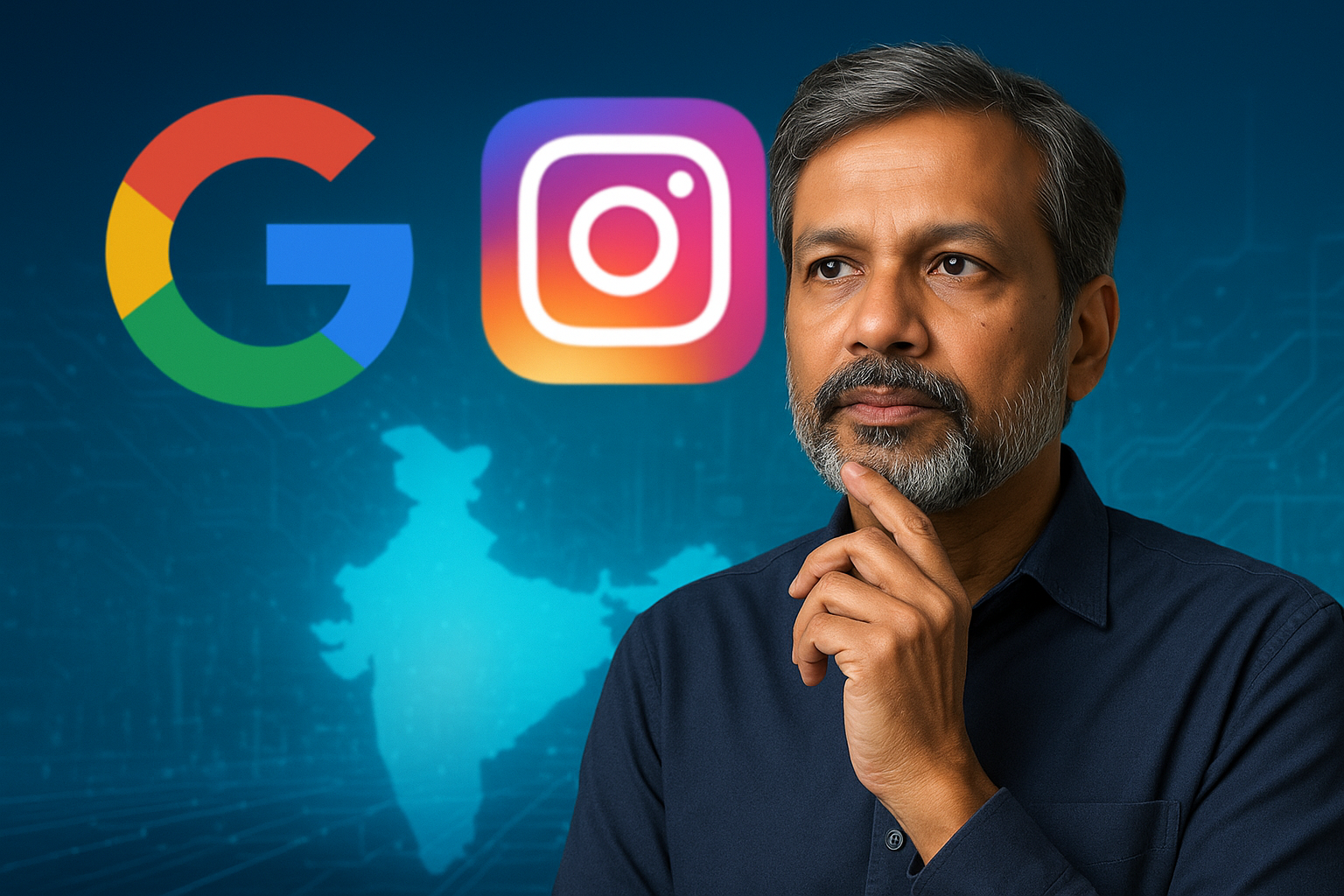
 A hypothetical scenario started trending on social media: “What if the USA bans Google and Instagram in India?”
The post quickly went viral, sparking nationwide debates on digital dependence, tech sovereignty, and the future of India’s internet ecosystem.
Amid the noise, Zoho Founder Sridhar Vembu stepped in with a sharp and thought-provoking response. His reply not only addressed the viral claim but opened a deeper discussion on India’s need for homegrown digital alternatives.
This article breaks down the controversy in simple, SEO-friendly, easy-to-read sections.
The Viral Claim
A graphic circulated widely on X (Twitter) and Instagram.
It suggested:
-
The USA might ban Google services in India.
-
Instagram, WhatsApp, and other American social media apps could also be blocked.
-
This would “collapse” India’s digital world.
While the claim was baseless, it triggered a massive response from users who depend on these platforms for work, communication, marketing, and daily life.
Why the Claim Went Viral
Several reasons pushed the rumor into national trending lists:
-
Heavy reliance on Google Search, Google Maps, Gmail, and YouTube.
-
Instagram and WhatsApp dominate India’s social media and communication landscape.
-
People fear sudden digital disruption, like the TikTok ban in India.
-
Ongoing global tech tensions create uncertainty.
The idea of an American tech shutdown in India felt shocking enough to ignite debate.
Zoho Founder Sridhar Vembu Responds
Sridhar Vembu, founder of Zoho—one of India’s biggest tech success stories—shared a calm, realistic perspective.
His key points:
1. India must not depend entirely on foreign tech
Vembu emphasized that a country of 1.4 billion people cannot rely only on American digital platforms.
He argued:
-
India needs its own search engines
-
Its own email and cloud services
-
Its own mapping solutions
-
Its own social media ecosystems
Dependence on foreign tech makes India digitally vulnerable.
2. Tech independence is long-term survival
Vembu stated that technological self-reliance is no longer optional.
It is essential for:
-
Digital security
-
Economic independence
-
Data sovereignty
-
Innovation within India’s borders
He pointed out that India can lose access to critical tools if geopolitical tensions rise.
This risk alone justifies building local alternatives.
3. India has the talent to build everything
According to Vembu:
-
India has world-class programmers
-
India builds software for global companies
-
India has the scale to support massive digital apps
The only missing piece is encouragement and investment in creating truly Indian platforms.
4. Bans are unlikely, but preparation is important
He clarified that the USA banning Google or Instagram in India is extremely unlikely—but the rumour teaches an important lesson:
India must be prepared for any possibility.
What Would Happen If Google Actually Got Banned in India?
Although unrealistic today, analyzing the scenario helps us understand India’s digital vulnerability.
1. Search Impact
-
Google controls over 94% of India’s search market.
-
Millions of businesses depend on Google for discovery and ranking.
-
Teachers, students, developers, and professionals rely on Google Search every day.
Without Google, the internet experience would change dramatically.
2. Maps and Navigation
-
Google Maps is used for taxis, deliveries, tourism, and daily commuting.
-
Platforms like Ola, Uber, Zomato, and Swiggy depend heavily on Maps.
A ban would instantly disrupt logistics and mobility.
3. YouTube Shutdown
-
India is YouTube’s largest market.
-
Lakhs of creators earn their livelihood from YouTube.
-
Education, entertainment, and news heavily rely on it.
A YouTube ban would impact both creators and consumers.
4. Instagram Ban
-
Influencers, small businesses, and startups rely on Instagram.
-
80% of Indian users follow a business on IG.
-
Daily sales, brand promotions, and marketing would suffer.
It would hit digital creators the hardest.
5. WhatsApp Ban
-
WhatsApp is the default communication tool for over 400 million Indians.
-
Families, businesses, schools, and government communications depend on it.
Its removal would cause immediate disruption.
Can India Survive Without American Tech?
Yes — but only with strong Indian alternatives.
India already has:
-
Zoho for cloud and business apps
-
Koo (paused now) as a Twitter alternative
-
Jio Platforms working on AI and digital tools
-
MapmyIndia for navigation
-
BharOS for operating systems
-
Tata Neu, JioMart, and others in e-commerce
But none match the scale and global influence of Google or Meta’s platforms.
Sridhar Vembu emphasized that India must invest aggressively in “Made in India” digital infrastructure.
Why Zoho’s Perspective Matters
Zoho is one of the few Indian tech companies that:
-
Operates globally
-
Competes with Google Workspace and Microsoft 365
-
Has millions of users across 180+ countries
-
Builds products entirely from India
-
Remains profitable without external funding
Vembu’s company proves that India can build world-standard software.
His voice carries weight in the digital sovereignty debate.
India’s Path to Digital Independence
To prepare for any future disruptions, India needs:
1. Government support for Indian tech companies
Policies, incentives, and funding to help local startups grow.
2. Strong public–private innovation
Collaboration between:
-
Startups
-
IT giants
-
Government
-
Academia
This will speed up development of core technologies.
3. Stronger data protection laws
To ensure Indian data stays within Indian borders.
4. Digital infrastructure at scale
India must invest in:
-
AI
-
Cloud systems
-
Search technologies
-
Social networking platforms
-
Mapping AI
-
Operating systems
These sectors are currently dominated by the USA and China.
5. Cultural acceptance of Indian apps
Indian users must be willing to trust and adopt homegrown platforms.
If the Ban Happened Today: Who Wins and Who Loses?
Winners
-
Indian tech startups
-
Indian cloud providers
-
Homegrown social media
-
New search engines and content platforms
A massive vacuum would accelerate innovation.
Losers
-
Digital marketers
-
YouTubers and influencers
-
Small businesses dependent on Instagram
-
Students and professionals relying on Google tools
-
App-based delivery and mobility companies
India would face immediate disruption before recovery.
Conclusion
The USA is not going to ban Google or Instagram in India anytime soon.
The viral post was fictional—but the conversation it sparked is real and important.
Zoho Founder Sridhar Vembu used the moment to highlight a powerful message:
A nation of India’s size must build its own digital backbone, instead of depending entirely on foreign platforms.
The debate shows that India is ready for a future where homegrown tech stands shoulder-to-shoulder with global giants.
Digital self-reliance is not just a dream anymore—it is a strategic necessity.