
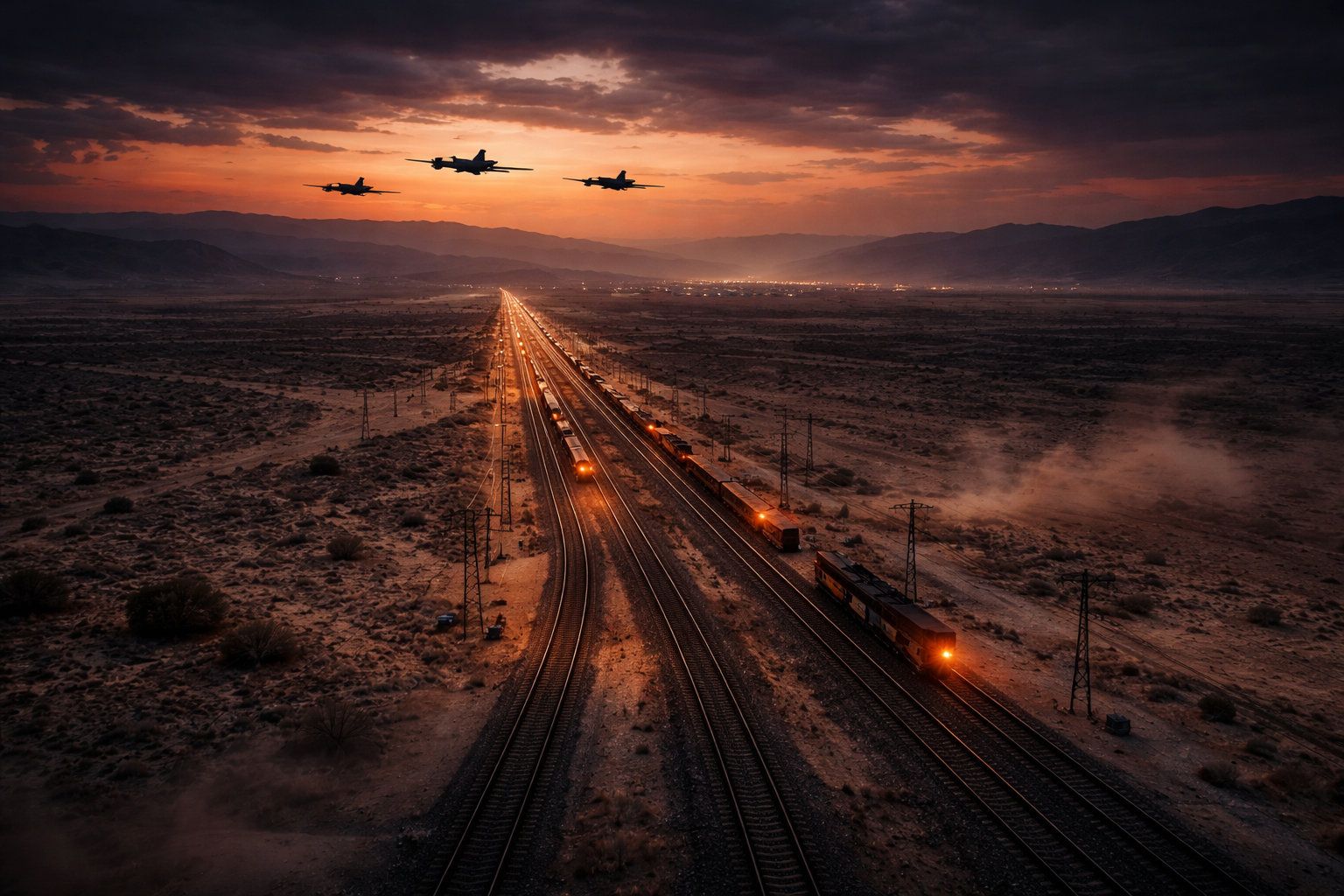
“Don’t Travel By Train Today”: Israel Warns Iranians, Hinting At A New Target
A warning. In Persian. Broadcast by Israel.
That alone tells you something major is unfolding.
 Israel has issued a rare public advisory — written in Farsi and directed at ordinary Iranian civilians — telling them to avoid travelling by train. No further explanation was given. But in the language of modern warfare, the message was unmistakably clear: a strike may be coming, and the railways are the target.
“Don’t use trains today.” — Israel’s rare Persian-language warning to Iranian civilians
This kind of public advisory is almost unheard of in Israeli military strategy. Israel almost never telegraphs its moves. So when it does speak directly to the Iranian public in their own language, the world takes notice.
This article breaks down what this warning means, why railways are being targeted, and what the destruction of Iran’s rail network could mean for the region’s balance of power.
Israel’s Rare Persian-Language Warning: What We Know
Israel’s advisory — circulated online and through various channels — urged Iranian citizens to refrain from using train services. While Israel did not explicitly claim responsibility for any upcoming attack, the advisory was widely interpreted as a direct signal of imminent military action.
This is not the first time Israel has used public messaging as part of its psychological and strategic operations. But targeting railways as an implied subject is a significant escalation in scope.
The warning was issued amid continued high tensions following a period of direct military exchanges between Israel and Iran. Both nations have traded missile and drone strikes, and analysts have noted that Israel appears to be shifting its targeting doctrine — moving beyond air defence systems and nuclear sites toward critical civilian-military infrastructure.
Why Railways? Understanding the Military Value of Rail Networks
At first glance, a railway might seem like civilian infrastructure. But in the context of modern warfare, railways are among the most strategically vital assets a nation can possess.
Here is why:
1. Troop Movement at Scale
Railways can move thousands of soldiers, along with their weapons and supplies, across vast distances in a matter of hours. Iran’s rail network connects its major cities and military hubs. In the event of a war, those rail lines become arteries for rapid troop deployment.
2. Missile and Heavy Weapons Transport
Ballistic missiles, artillery systems, and armoured vehicles are heavy — far too heavy for road transport at scale. Rail is the only practical way to move large quantities of these weapons quickly. Iran is known to stockpile missiles across multiple regions. The railways are how those missiles reach the front.
3. Fuel and Ammunition Logistics
A war machine runs on fuel, food, and ammunition. Rail networks allow for the continuous resupply of front-line positions. Cut the railways, and even a well-armed military can grind to a halt within days.
4. Connecting Military Bases to Operational Fronts
Iran maintains military installations across its territory. Many of these bases are connected to operational zones through rail corridors. Disrupting those corridors doesn’t just delay reinforcements — it isolates bases entirely.
Destroy the railway. Paralyse the army. It’s a strategy as old as modern warfare itself.
Lessons From History: When Railways Became War Targets
This is not a new concept. History offers clear evidence of how devastating railway strikes can be.
- In World War II, Allied forces systematically bombed Nazi Germany’s railway infrastructure. The result was a near-total collapse of Germany’s ability to move troops and supplies. Many historians credit the rail campaign as one of the decisive factors in ending the war.
- During the Korean War, UN forces targeted North Korean rail lines to sever supply chains from China. The campaigns were so effective that North Korea struggled to sustain its frontline forces.
- In the Russia-Ukraine conflict, railway infrastructure has been a consistent target on both sides. Ukraine’s ability to receive Western military aid has depended heavily on keeping its western rail lines operational.
The pattern is consistent. Rail is not just logistics. Rail is power.
What Iran’s Railway Network Looks Like
Iran has one of the most extensive rail networks in the Middle East. It spans over 15,000 kilometres, connecting Tehran with major cities including Isfahan, Tabriz, Mashhad, Ahvaz, and Bandar Abbas — the country’s key port on the Persian Gulf.
This network is not just for passengers. It is deeply integrated into Iran’s military and industrial supply chain. The rail corridor to Bandar Abbas, for instance, is critical for importing goods that bypass international sanctions. The same corridor could theoretically be used to move military supplies.
A targeted strike on key junctions — particularly around Tehran, Isfahan, or the southern rail corridor — could cripple Iran’s ability to respond militarily in multiple directions simultaneously.
The Bigger Picture: A Shift in Israeli Strategy?
Israel’s implied warning about railways suggests a possible evolution in how it is thinking about a potential conflict with Iran.
Previous Israeli strikes focused on:
- Iran’s nuclear facilities and research sites
- Air defence radar systems
- Weapons storage depots
- Iranian proxy militia positions in Syria and Iraq
Targeting railways signals a shift toward degrading Iran’s strategic mobility — not just its weapons capability.
The logic is straightforward. Iran can rebuild a missile launcher. It can replace a radar system. But rebuilding hundreds of kilometres of destroyed rail infrastructure takes years and costs billions of dollars. The damage lingers long after the conflict ends.
Infrastructure warfare doesn’t just win battles — it shapes the post-war balance of power for decades.
What This Means for Iranian Civilians
Israel’s warning, notably, was addressed to ordinary Iranians — not to the government, not to the military. This has both strategic and humanitarian dimensions.
On the strategic side, it creates panic and uncertainty within Iran. When civilians begin avoiding trains — even out of precaution — it disrupts normal rail operations, which already strains the logistics network before a single bomb is dropped.
On the humanitarian side, it reflects a deliberate attempt to avoid mass civilian casualties. Israel appears to be signalling its intentions publicly to reduce collateral damage — a move that mirrors similar warnings it has issued in Gaza and Lebanon in the past.
Whether that warning is heeded, however, depends on how much the Iranian public trusts the signal — and how quickly the government responds.
Key Takeaways
- Israel issued a rare Persian-language public advisory warning Iranians to avoid train travel.
- The warning is widely interpreted as a signal of an imminent strike on Iran’s railway infrastructure.
- Railways are critical military assets — used to move troops, missiles, fuel, and heavy equipment.
- Historically, targeting railways has been one of the most effective ways to cripple a nation’s military capability.
- Iran’s railway network spans over 15,000 km and connects key military and industrial hubs.
- This may signal a strategic shift in Israel’s approach — from targeting weapons to targeting mobility.
Final Word
A few words in Persian. Broadcast quietly. But heard loudly across the world.
Israel’s warning to Iranians about train travel is more than a precaution. It is a strategic message — that the next phase of this conflict may target not just Iran’s weapons, but its ability to move them.
In modern warfare, logistics is everything. And railways are the backbone of logistics.
When the trains stop running, armies stop moving. And that — more than any missile or airstrike — is what changes the outcome of wars.
Stay informed. Stay ahead