
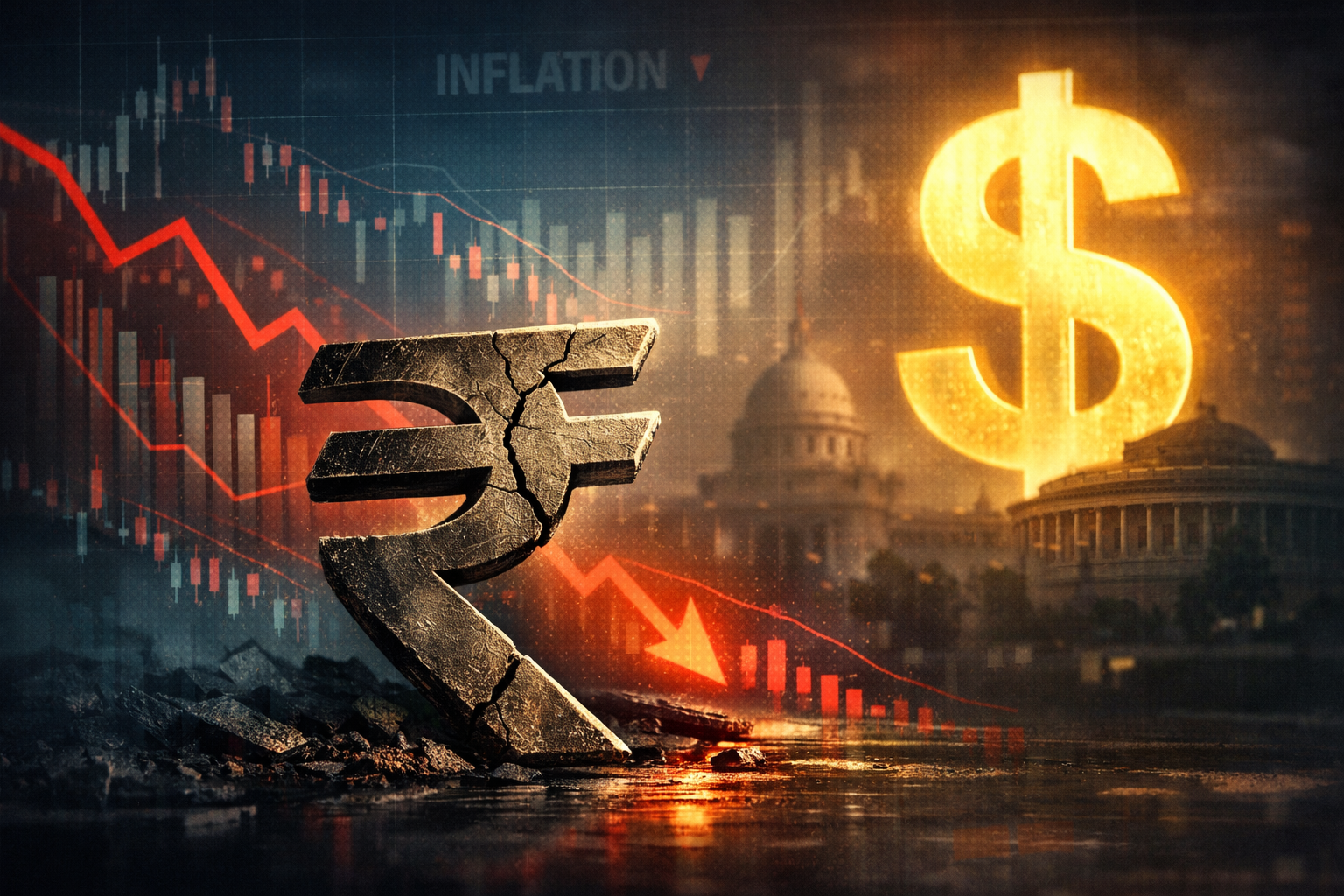
 The Indian Rupee is under sustained pressure, weakening steadily against the US Dollar. What once appeared to be a manageable currency movement is now raising serious macroeconomic concerns.
According to Bank of America (BofA), the declining Rupee is no longer just a forex issue. It has become a five-channel threat to India’s economy, impacting confidence, growth, inflation, external stability, and fiscal health.
This warning comes at a time when global uncertainty, strong US dollar momentum, and capital flow volatility are already challenging emerging markets like India.
In this article, we break down what Rupee weakness means, why BofA is concerned, and how these five channels could affect India’s economic stability.
Indian Rupee Continues to Weaken Against the US Dollar
The Indian Rupee has been on a continuous downward trend against the US Dollar in recent months.
Several factors are contributing to this decline:
-
A strong US Dollar driven by higher US interest rates
-
Persistent global geopolitical tensions
-
Foreign investor outflows from emerging markets
-
Rising import bills, especially for oil and commodities
While mild currency depreciation can help exports, prolonged Rupee weakness is a warning sign of deeper macroeconomic stress.
Bank of America believes this trend deserves urgent attention.
Bank of America Issues Warning on Rupee Weakness
In a recent assessment, Bank of America warned that Rupee depreciation has evolved into a multi-dimensional risk.
BofA identified five interconnected channels through which a weak Rupee could damage India’s economy:
-
Sentiment and confidence
-
Economic growth
-
Inflation
-
External balance
-
Fiscal stability
These channels do not operate independently. Instead, they reinforce each other, amplifying the overall risk.
Channel 1: Sentiment and Confidence Takes a Hit
The first and most immediate impact of Rupee weakness is on market sentiment and investor confidence.
A falling currency sends a clear signal to investors that:
-
Macroeconomic pressures are building
-
External vulnerabilities are increasing
-
Policy challenges may lie ahead
Foreign investors often respond by reducing exposure to Indian assets, including equities and bonds.
This leads to:
-
Lower capital inflows
-
Higher market volatility
-
Pressure on stock indices
Once confidence erodes, restoring it becomes difficult, making sentiment a critical risk channel.
Channel 2: Slower Economic Growth
The second channel identified by BofA is economic growth.
A weak Rupee increases the cost of imports, particularly:
-
Crude oil
-
Industrial raw materials
-
Technology and capital goods
Higher import costs raise production expenses for businesses.
As a result:
-
Corporate profit margins shrink
-
Investment decisions are delayed
-
Expansion plans are put on hold
Over time, these effects can slow GDP growth, especially in manufacturing and infrastructure-heavy sectors.
Channel 3: Rising Inflation Pressures
Inflation is one of the most direct consequences of currency depreciation.
India is a major importer of:
-
Crude oil
-
Natural gas
-
Fertilizers
-
Electronics
When the Rupee weakens, imported goods become more expensive in local currency terms.
This leads to:
-
Higher fuel prices
-
Increased transportation costs
-
Costlier food production
Rising inflation reduces household purchasing power and forces the Reserve Bank of India (RBI) to maintain tighter monetary conditions.
Higher interest rates can further dampen growth.
Channel 4: Worsening External Balance
The fourth channel is the external balance, particularly the current account deficit (CAD).
A weak Rupee can widen the trade deficit because:
-
Import bills increase
-
Export gains may not fully offset higher costs
If export demand remains weak due to global slowdown, the benefit of a cheaper currency becomes limited.
A widening current account deficit increases India’s dependence on foreign capital inflows to finance the gap.
This raises external vulnerability during periods of global risk aversion.
Channel 5: Fiscal Stability Comes Under Pressure
The fifth channel highlighted by Bank of America is fiscal stability.
Rupee depreciation impacts government finances in several ways:
-
Higher subsidy costs for fuel and fertilizers
-
Increased interest payments on foreign debt
-
Pressure to support key sectors and consumers
At the same time, slower growth can reduce tax collections.
This combination makes it harder for the government to control fiscal deficits, potentially affecting India’s sovereign ratings and borrowing costs.
Weak Rupee Signals Deeper Macroeconomic Stress
BofA emphasizes that a persistently weak Rupee is not just a currency issue.
It reflects:
-
Reduced capital inflows
-
Heightened global risk perception
-
Structural challenges in external financing
When foreign investors turn cautious, capital inflows slow down, making the economy more vulnerable to external shocks.
This creates a cycle where currency weakness and macro stress feed into each other.
Interaction of the Five Channels Increases Risk
One of the key points in BofA’s warning is that these five channels interact and amplify risks.
For example:
-
Weak sentiment reduces capital inflows
-
Lower inflows worsen external balance
-
External pressure weakens the Rupee further
-
Inflation rises, forcing tighter policy
-
Tighter policy slows growth
This interconnected nature makes Rupee weakness a systemic risk, not a standalone problem.
What Policymakers Need to Watch Closely
Given these risks, BofA suggests careful monitoring and policy adjustments.
Key focus areas include:
-
Managing inflation without hurting growth
-
Maintaining adequate foreign exchange reserves
-
Supporting investor confidence
-
Controlling fiscal deficits
-
Encouraging stable long-term capital inflows
The RBI’s currency management and the government’s fiscal discipline will play a critical role in navigating this challenge.
Global Factors Also Play a Major Role
It is important to note that Rupee weakness is not entirely domestic.
Global factors influencing the currency include:
-
US Federal Reserve interest rate policy
-
Global risk-off sentiment
-
Geopolitical conflicts
-
Commodity price volatility
However, strong domestic fundamentals can help cushion these external shocks.
Conclusion: A Growing Economic Warning Signal
The weakening Indian Rupee has emerged as a serious economic warning, according to Bank of America.
What started as a currency trend is now a five-channel threat affecting sentiment, growth, inflation, external balance, and fiscal stability.
The interaction of these channels increases the risk to India’s overall economic stability.
While India remains one of the world’s fastest-growing major economies, persistent Rupee weakness requires close attention, timely policy action, and strong macroeconomic management.
How policymakers respond in the coming months will determine whether this warning turns into a crisis—or remains a manageable challenge.
What is Bank of America’s warning on the Indian Rupee?
Bank of America has warned that the weakening Indian Rupee is creating risks across five economic channels—sentiment, growth, inflation, external balance, and fiscal stability—posing a broader threat to India’s macroeconomic stability.
Why is the Indian Rupee weakening against the US Dollar?
The Rupee is weakening due to a strong US Dollar, higher US interest rates, foreign investor outflows, rising import costs, and global geopolitical uncertainty.
How does Rupee weakness affect inflation in India?
A weaker Rupee makes imports like crude oil, gas, and electronics more expensive, increasing fuel and transportation costs and adding pressure to overall inflation.
Can Rupee depreciation slow India’s economic growth?
Yes. Higher import costs raise production expenses for businesses, reduce profit margins, and delay investments, which can slow overall economic growth.
What does Rupee weakness mean for investors?
For investors, a falling Rupee signals rising macroeconomic risk, lower capital inflows, increased volatility, and potential pressure on equity and bond markets.