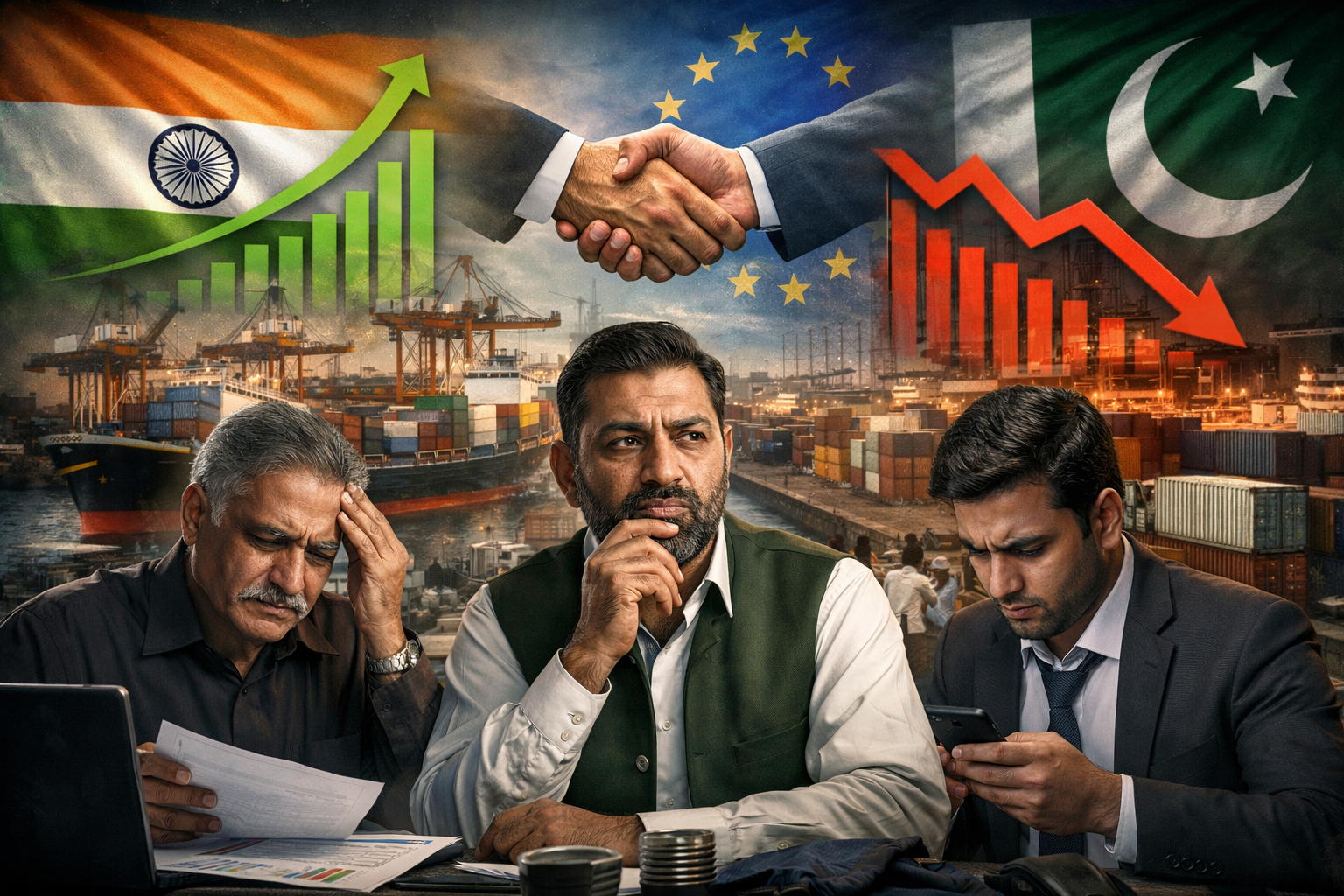
 The newly announced India–EU trade deal is creating shockwaves across South Asia.
While India and the European Union celebrate a stronger economic partnership, neighboring Pakistan is watching with growing concern.
Pakistani exporters say the agreement could seriously damage their export sector, especially textiles.
Industry leaders are already warning the government that urgent action is needed.
If not, Pakistan could lose one of its biggest advantages in the European market.
And that could hurt the country’s economy badly.
Why the India–EU Trade Deal Matters
The European Union is one of the world’s largest trading blocs.
It imports billions of dollars worth of textiles, garments, machinery, and agricultural products every year.
For countries like India and Pakistan, the EU is a key export destination.
So any change in tariffs or trade rules directly affects their businesses.
The new India–EU Free Trade Agreement (FTA) aims to reduce or eliminate tariffs on many Indian products.
This makes Indian goods cheaper and more attractive to European buyers.
That’s good news for India.
But for Pakistan, it’s a serious threat.
Pakistan’s Historic Advantage in Europe
For years, Pakistan enjoyed a special edge in the EU market.
Under the GSP+ (Generalized System of Preferences Plus) scheme, Pakistan exported many goods to Europe with zero tariffs.
Meanwhile, India faced around 12% tariffs on textiles.
This gave Pakistan a clear price advantage.
European buyers often chose Pakistani products because they were cheaper.
This helped Pakistan build a strong textile presence.
Textiles became the backbone of its export economy.
Millions of jobs depend on this sector.
How the India–EU Deal Changes Everything
Now the situation is changing fast.
If India gets lower or zero tariffs under the new trade deal, the playing field becomes equal.
Or even worse for Pakistan.
Indian manufacturers already have stronger infrastructure, larger factories, and better logistics.
If tariff benefits are added, India could undercut Pakistan on prices.
European buyers may shift their orders to Indian suppliers.
This could reduce Pakistan’s export volumes sharply.
Pakistani exporters fear this could lead to factory closures and job losses.
Panic Among Pakistani Exporters
Business groups in Pakistan are sounding the alarm.
Textile exporters say they are “in a state of panic.”
They worry that orders will move away from Pakistan within months.
Several industry leaders have urged the government to act immediately.
They want new trade policies.
They want incentives.
And they want faster reforms.
Without action, they believe the export sector could collapse.
Why Textiles Are Most at Risk
Pakistan’s economy relies heavily on textiles.
Nearly 60% of total exports come from this single sector.
From cotton yarn to garments, Europe is a major buyer.
If the EU starts favoring Indian products, Pakistan’s losses could be huge.
Small factories may not survive intense price competition.
Profit margins are already thin.
Even a small shift in tariffs can make a big difference.
This is why exporters are worried the most.
India’s Growing Strength in Manufacturing
India is not just benefiting from tariff cuts.
It is also improving its manufacturing capabilities.
The country has invested heavily in:
-
Modern factories
-
Better technology
-
Faster ports
-
Skilled labor
-
Government incentives
All these factors reduce costs.
Combined with tariff advantages, India becomes a powerful competitor.
European companies may find India more reliable and scalable.
That puts extra pressure on Pakistan.
What Pakistani Exporters Want
Exporters are asking their government for immediate support.
They believe strong policies can still protect the industry.
Some key demands include:
-
New trade agreements with the EU
-
Better incentives for textile producers
-
Lower energy costs
-
Improved infrastructure
-
Faster customs processes
-
Currency stability
They say without reforms, Pakistan cannot compete with India’s speed and scale.
Time is critical.
The Risk to Pakistan’s Economy
This issue is bigger than just textiles.
If exports fall, the entire economy suffers.
Lower exports mean:
-
Less foreign exchange
-
Weaker currency
-
Higher inflation
-
Fewer jobs
-
Slower growth
Pakistan already faces economic challenges.
A drop in export earnings could make things worse.
That’s why analysts say this trade deal is a “wake-up call.”
The country must modernize quickly.
Can Pakistan Still Compete?
The situation is serious but not hopeless.
Pakistan still has strengths.
It produces high-quality cotton.
Its labor costs are competitive.
It has long experience in textile production.
If the government supports modernization, the industry can survive.
But standing still is not an option.
Competing with India now requires smarter strategies.
Steps Pakistan Must Take
Experts suggest several solutions.
First, diversify exports beyond textiles.
Relying on one sector is risky.
Second, improve productivity with technology.
Third, negotiate better trade terms with Europe.
Fourth, reduce energy and transport costs.
Fifth, invest in branding and value-added products.
Instead of only raw textiles, Pakistan can sell premium garments and finished goods.
Higher value means better profits.
A Turning Point for South Asian Trade
The India–EU trade deal marks a new phase in regional trade competition.
It shows how quickly global markets can change.
Countries that adapt will grow.
Those that delay reforms may struggle.
For India, this deal opens doors.
For Pakistan, it sends a warning.
Exporters must prepare for tougher competition.
And governments must move fast.
Final Thoughts
The India–EU trade deal is more than just an agreement between two partners.
It has regional consequences.
Pakistani exporters are right to be concerned.
Their long-held tariff advantage is disappearing.
Without quick action, the textile sector could face serious losses.
But with smart reforms and better policies, Pakistan can still protect its position.
This moment should not create fear alone.
It should create urgency.
Because in global trade, speed matters.
Those who adapt first win.