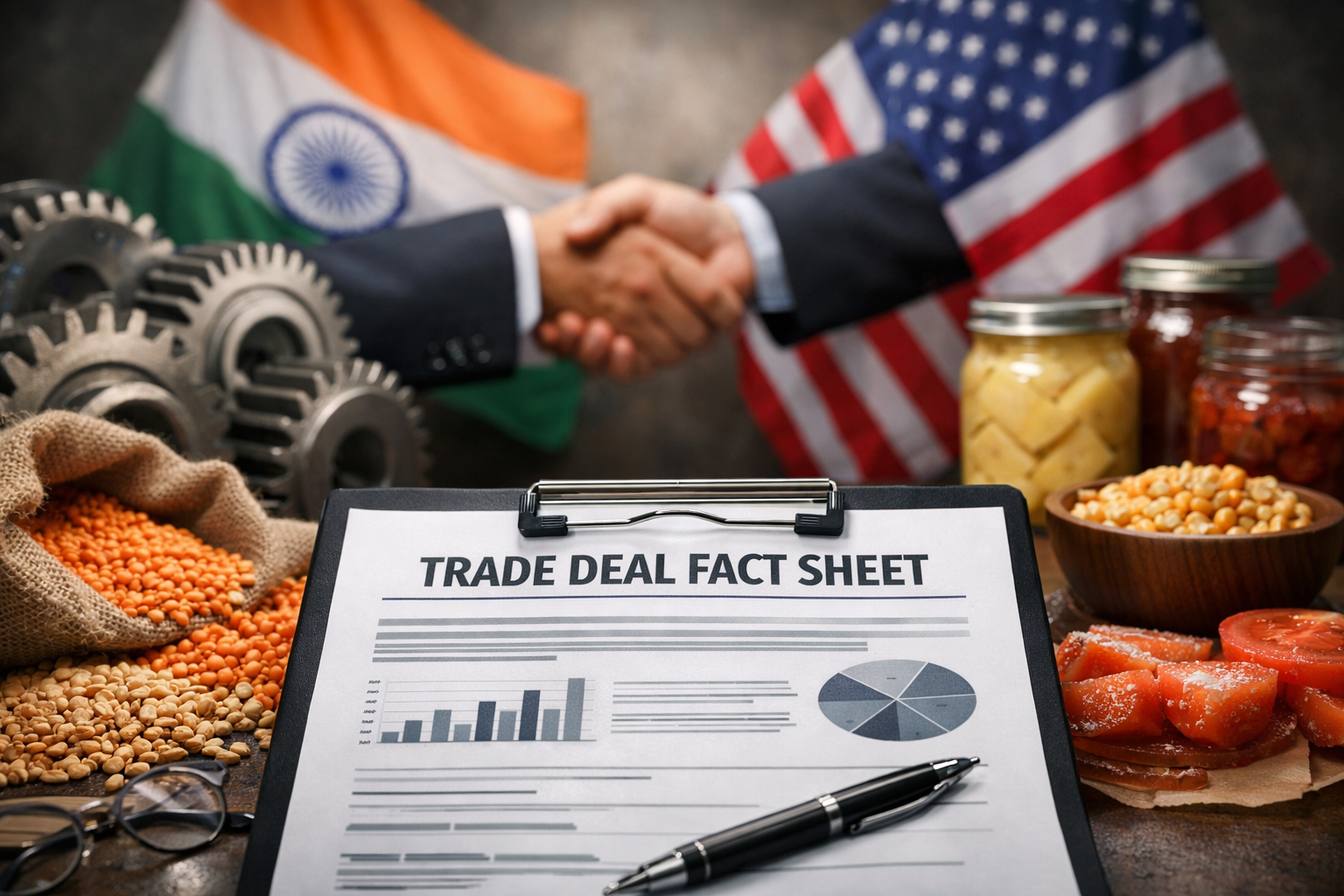
 The US revises India-US trade deal fact sheet, and once again, the spotlight is on the evolving trade relationship between the two nations.
Trade talks between India and the United States have always attracted global attention. But recent developments have added fresh uncertainty, especially due to conflicting public statements and political pressure.
In this article, we break down what the revised fact sheet means, why it matters, and how it could impact sensitive sectors like agriculture, machinery, and processed foods.
Why the India-US Trade Deal Matters
India and the United States share a strong economic partnership.
The US is one of India’s largest trading partners. Bilateral trade between the two countries runs into hundreds of billions of dollars annually.
Any revision in trade agreements affects:
-
Exporters
-
Farmers
-
Industrial manufacturers
-
Consumers
-
Investors
That’s why the revision of the India-US trade deal fact sheet is significant.
Trump’s Statements vs Ground Reality
One major point discussed in recent commentary is the unpredictability of former US President Donald Trump’s statements regarding the India-US trade deal.
Trump often made bold announcements.
However, many of those statements did not fully match the details in official documents.
For example, Trump once announced that India would purchase $500 billion worth of goods from the United States.
This statement raised eyebrows.
Experts questioned whether such a massive commitment had actually been agreed upon in formal negotiations.
The $500 Billion Purchase Claim
The claim of a $500 billion goods purchase created pressure.
Many believed that India may have felt diplomatic pressure to appear cooperative.
However, trade experts pointed out:
-
No official confirmation of such a large purchase commitment
-
Lack of detailed breakdown of goods
-
Absence of timeline for execution
The revision of the fact sheet appears to clarify some of these misunderstandings.
This shows the importance of separating political messaging from official trade documents.
Sensitive Issue: Pulses in India
One of the most sensitive topics in the India-US trade negotiations is pulses.
Pulses are a staple in Indian households.
They are also crucial for millions of Indian farmers.
If tariffs on imported pulses are reduced significantly, it could:
-
Lower domestic prices
-
Increase US exports to India
-
Impact Indian farmers’ income
That’s why any mention of tariff reduction on pulses immediately becomes controversial.
The revised trade fact sheet reportedly addresses concerns related to agricultural products, including pulses.
Why Pulses Are Politically Sensitive
Agriculture in India is not just an economic issue.
It is deeply political.
Millions of small and marginal farmers depend on crops like:
-
Lentils
-
Chickpeas
-
Pigeon peas
-
Other pulses
Lower import tariffs could benefit consumers in the short term.
But farmers may face losses due to cheaper imports.
This balance makes trade negotiations extremely delicate.
Tariff Reductions on Key Goods
Another major discussion point is tariff reductions.
The trade deal may lead to significant cuts in tariffs on various goods.
Some of the goods mentioned include:
-
Industrial machinery
-
Dry distilleries
-
Grains
-
Processed fruits
Let’s examine each category.
Industrial Machinery
The US has a strong industrial manufacturing sector.
If tariffs on US industrial machinery are reduced:
-
Indian industries may get access to advanced technology
-
Production efficiency could improve
-
Costs of machinery imports may decline
However, domestic manufacturers in India may face stronger competition.
This could reshape India’s industrial landscape.
Dry Distilleries and Agricultural Processing
Dry distilleries are used in ethanol production and agricultural processing.
Reduced tariffs in this segment could:
-
Strengthen energy cooperation
-
Boost ethanol blending initiatives
-
Encourage technology exchange
India is already pushing for higher ethanol blending in fuel.
This could align with broader trade and energy goals.
Grains and Processed Fruits
Grains and processed fruits are also part of the ongoing trade discussions.
Market openness in these sectors remains controversial.
For grains:
-
India is protective of its farmers
-
Food security is a national priority
For processed fruits:
-
The US seeks greater access to Indian markets
-
Indian producers fear market displacement
The revised fact sheet may attempt to clarify the extent of tariff changes.
But the real impact depends on implementation.
Market Openness: The Core Controversy
At the heart of the India-US trade deal is the issue of market openness.
The US wants broader access to Indian markets.
India wants fair treatment for its exports, especially in:
-
Pharmaceuticals
-
IT services
-
Textiles
-
Agricultural goods
Both sides aim to protect domestic interests.
This push and pull is common in global trade negotiations.
Political Messaging vs Official Documents
One key lesson from this episode is the difference between political messaging and official agreements.
Public announcements often sound dramatic.
But trade agreements are technical and detailed.
When the US revises India-US trade deal fact sheet, it usually means:
-
Clarification of earlier claims
-
Correction of figures
-
Alignment with formal commitments
Investors and businesses rely on official documents, not speeches.
Impact on Indian Farmers
Indian farmers are watching closely.
Any reduction in tariffs on pulses or grains directly affects them.
Possible outcomes include:
-
Lower prices in domestic markets
-
Increased competition from US imports
-
Need for government support measures
The Indian government must balance:
-
Trade commitments
-
Rural economic stability
-
Political pressure
This makes negotiations complex.
Impact on US Exporters
For the US, India represents a massive consumer market.
Reduced tariffs could mean:
-
Higher exports
-
Stronger trade surplus
-
Increased business opportunities
US farmers and manufacturers are eager for better access.
That is why trade talks continue despite political changes.
Strategic Importance of the Trade Deal
Beyond economics, the India-US trade relationship has strategic importance.
Both countries are key partners in:
-
Indo-Pacific security
-
Technology cooperation
-
Defense partnerships
Trade agreements often strengthen diplomatic ties.
However, disagreements can create tension.
That’s why clear and accurate communication is essential.
Why the Revision Matters
When the US revises the India-US trade deal fact sheet, it signals transparency.
It also shows that earlier statements may have overstated commitments.
For businesses, this revision provides:
-
Clearer expectations
-
Reduced uncertainty
-
Better planning opportunities
For policymakers, it offers a chance to reset the narrative.
The Bigger Picture
Trade negotiations are rarely simple.
They involve:
-
Economic calculations
-
Political considerations
-
Domestic pressure groups
-
International diplomacy
The discussion around the $500 billion claim shows how political rhetoric can complicate negotiations.
The reality is usually more measured and technical.
What to Watch Next
Going forward, key areas to monitor include:
-
Final tariff rates on pulses and grains
-
Commitments on industrial machinery imports
-
Implementation timelines
-
Domestic policy adjustments in India
Any official update from trade ministries will provide more clarity.
Conclusion: Understanding the Real Implications
The revision of the US India trade deal fact sheet highlights an important lesson.
Statements made in public may not always reflect official agreements.
Sensitive sectors like pulses and grains require careful handling.
Tariff reductions can bring opportunities but also challenges.
India must protect its farmers while engaging in global trade.
The United States seeks greater market access while strengthening strategic ties.
Understanding the real implications of these negotiations is essential for:
-
Farmers
-
Businesses
-
Policymakers
-
Investors
As the India-US trade relationship evolves, clarity and transparency will remain crucial.
The revised fact sheet is not just a document.
It is a reminder that global trade is complex, political, and deeply interconnected.
And for both India and the United States, the stakes remain high.