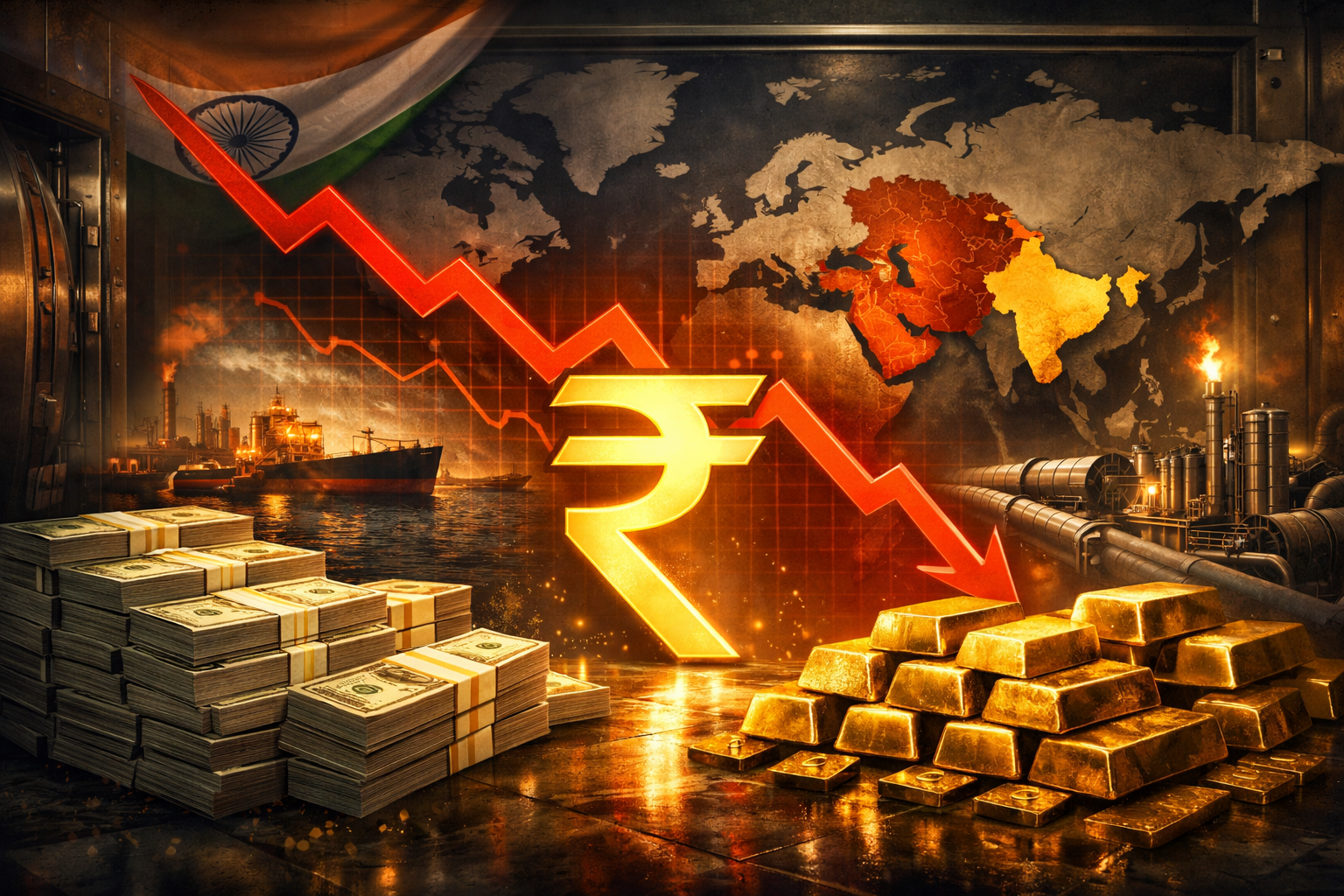
 India’s foreign exchange reserves have recently recorded their largest weekly fall in more than a year. The sudden drop has sparked discussions among economists, investors, and policymakers.
Many people are now asking an important question: Is India heading toward a financial crisis like 1991?
In reality, the situation is more complex. The decline is linked to global geopolitical tensions, especially in the Middle East, and movements in global currency markets.
This article explains why India’s forex reserves have fallen, the current reserve level, and whether the country should actually worry.
What Are Forex Reserves?
Before understanding the fall, it is important to know what forex reserves are.
Foreign exchange reserves are assets held by a country’s central bank in foreign currencies. In India, these reserves are managed by the Reserve Bank of India.
Forex reserves typically include:
-
US dollars
-
Euros
-
British pounds
-
Japanese yen
-
Gold reserves
-
Special Drawing Rights (SDRs)
-
Reserve position with the International Monetary Fund
These reserves are used to:
-
Stabilize the currency
-
Manage international trade payments
-
Handle economic shocks
-
Maintain investor confidence
For a country like India, which imports large amounts of oil and goods, strong forex reserves are extremely important.
India’s Forex Reserves See Biggest Drop in Over a Year
Recent data shows that India’s forex reserves have dropped sharply, marking the biggest decline in more than 12 months.
The fall is significant enough to attract attention from global financial markets.
The decline reflects:
-
Currency market intervention
-
Rising oil prices
-
Global geopolitical tensions
-
Capital outflows
Despite the fall, India still maintains one of the largest forex reserve holdings in the world.
The country remains among the top 5 countries globally in foreign exchange reserves.
Middle East Tensions Affect Global Markets
A major factor behind the drop in reserves is the rising geopolitical tension in the Middle East.
The conflict involving the Iran and the United States has created uncertainty in global energy markets.
The strategic oil route known as the Strait of Hormuz has become a major concern.
Nearly 20% of the world’s oil supply passes through this narrow sea route.
Any disruption in this region affects global oil prices immediately.
Since India imports more than 80% of its crude oil, rising prices put pressure on the country’s foreign currency reserves.
Why Forex Reserves Are Falling
There are several key reasons behind the recent decline.
1. Currency Stabilization by RBI
The Reserve Bank of India often sells US dollars from reserves to stabilize the Indian rupee.
When the rupee weakens due to global tensions, the central bank intervenes to prevent excessive volatility.
This intervention leads to a temporary drop in forex reserves.
2. Rising Oil Import Bills
India’s economy relies heavily on imported energy.
When oil prices rise due to Middle East tensions, the country needs more dollars to pay for imports.
This directly impacts forex reserves.
3. Global Investor Movements
Foreign investors sometimes withdraw money from emerging markets during periods of global uncertainty.
When this happens, dollars flow out of the country.
To manage the pressure on the rupee, the RBI may again use forex reserves.
Current Level of India’s Forex Reserves
Even after the recent fall, India’s forex reserves remain strong and stable by global standards.
The reserves are still well above $600 billion, providing a strong cushion for the economy.
This level is enough to cover:
-
Several months of imports
-
External debt obligations
-
Currency market shocks
In fact, India’s reserves today are many times larger than what the country had three decades ago.
Comparing the Situation with the 1991 Crisis
Whenever forex reserves fall, people often recall the famous economic crisis of 1991.
The 1991 Indian Economic Crisis was one of the most difficult periods in India’s financial history.
At that time:
-
India had forex reserves for only two weeks of imports
-
The government had to pledge gold reserves
-
The country approached the International Monetary Fund for emergency support
This crisis eventually led to major economic reforms that opened India’s economy to global markets.
Why Today’s Situation Is Very Different
While the headlines about falling reserves may sound alarming, today’s situation is very different from 1991.
Here are the key differences.
Strong Reserve Buffer
India currently has over $600 billion in reserves, compared to just a few billion in 1991.
Stable Economic Growth
India remains one of the fastest growing major economies in the world.
Diversified Economy
The country now has strong sectors including:
-
IT services
-
Manufacturing
-
Pharmaceuticals
-
Digital economy
Improved Financial Policies
Economic reforms after the 1991 crisis have strengthened financial management and foreign investment flows.
Lessons from the 1991 Economic Crisis
Although the current situation is not alarming, the 1991 crisis still offers valuable lessons.
Key takeaways include:
1. Maintain strong forex reserves
A large reserve buffer protects the economy during global shocks.
2. Reduce dependence on imports
Energy security remains critical for India.
3. Diversify export markets
Higher exports help bring more foreign currency into the country.
4. Strengthen economic reforms
Structural reforms improve long-term stability.
These lessons have helped India build a much stronger financial system today.
How the RBI Manages Forex Stability
The Reserve Bank of India uses several tools to manage foreign exchange stability.
These include:
-
Dollar market intervention
-
Interest rate adjustments
-
Liquidity management
-
Monitoring capital flows
The RBI’s goal is not to prevent currency movement entirely, but to avoid sudden and extreme volatility.
This helps protect businesses, importers, and investors.
Impact on the Indian Economy
The fall in forex reserves does not immediately damage the economy.
However, it can have some indirect effects.
Possible impacts include:
-
Rupee volatility
-
Higher import costs
-
Inflation pressure
-
Market uncertainty
Despite this, India’s strong reserves provide a large safety buffer.
What Experts Are Saying
Many economists believe the recent decline is temporary and manageable.
Global events often create short-term volatility in forex reserves.
As geopolitical tensions stabilize, reserves may recover again.
India’s strong economic fundamentals continue to support investor confidence.
The Road Ahead for India’s Forex Reserves
India’s economic outlook remains positive.
Several factors could strengthen forex reserves in the coming months.
These include:
-
Rising exports
-
Strong foreign investment
-
Stable oil prices
-
Global economic recovery
If these trends continue, reserves could grow again in the near future.
Conclusion
India’s forex reserves have indeed recorded their largest fall in over a year, mainly due to geopolitical tensions and global economic uncertainty.
However, the situation is far from a crisis.
Unlike during the 1991 Indian Economic Crisis, India now has massive foreign exchange reserves, a diversified economy, and strong financial institutions.
The temporary decline reflects global market pressures rather than domestic economic weakness.
With over $600 billion in reserves and steady economic growth, India remains well prepared to handle external shocks.
For now, the fall in forex reserves is a situation to watch, not a reason to panic.