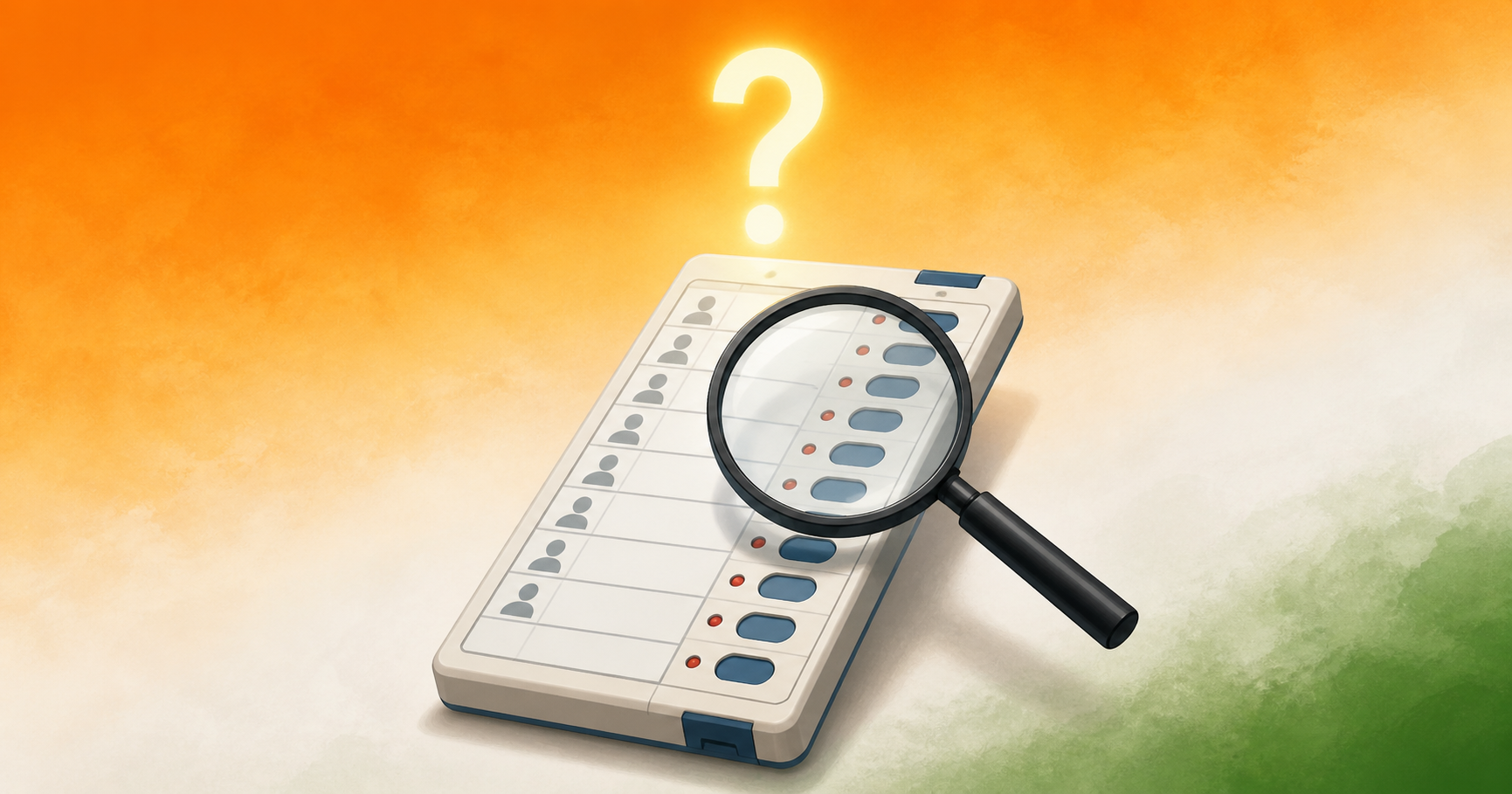
Why Mamata Banerjee Is Pressing the EVM Panic Button
Every election season in India comes with a familiar script — votes are cast, results arrive, and the losing side points fingers at the Electronic Voting Machine. This time, it is Mamata Banerjee’s Trinamool Congress raising the alarm in West Bengal. But how valid are these concerns, and what is really going on?
The EVM Controversy: A Never-Ending Loop
 The debate around Electronic Voting Machines in India is not new. It has been raised by virtually every major political party at some point — including the Bharatiya Janata Party itself. Back when the BJP was in opposition, its leaders loudly questioned the reliability of EVMs. Today, the tables have turned, and it is the opposition benches pointing at alleged tampering.
This recurring cycle tells us something important: EVM allegations are often less about technology and more about political strategy. When a party loses, the machine becomes the convenient scapegoat. When a party wins, the machine is perfectly trustworthy.
What Mamata Banerjee Did — And Why It Made Headlines
In the lead-up to results in the West Bengal elections, Mamata Banerjee took an unusual step — she personally visited a strong room where EVMs were being stored. Her presence, accompanied by TMC workers and party officials, turned into a high-visibility protest outside the facility.
Strong rooms are secure, sealed locations where EVMs are kept after polling ends and before counting begins. By showing up there, Mamata sent a clear political message: she does not trust the process. Whether that distrust is genuine or theatrical depends on who you ask.
The protests around EVM storage locations drew significant media attention and put the Election Commission on the defensive — which, politically speaking, was likely the whole point.
How Secure Are EVMs Really?
Here is what the facts say. EVMs in India go through a layered, multi-agency security protocol once polling is over.
The strong rooms are locked and sealed in the presence of candidates’ representatives. Once sealed, no single authority can access them alone — it requires multiple parties to be present. CCTV cameras monitor these locations around the clock, and all-party agents are allowed to station themselves outside.
The multi-layered security design exists precisely to prevent tampering — and to ensure that if anyone tries, there are enough witnesses to catch it. To date, no concrete forensic evidence of EVM manipulation has been produced in any Indian court.
The Postal Ballot Angle
One aspect of elections that often gets lost in the EVM debate is the postal ballot system — and it deserves attention here.
Postal ballots are used by a specific group of voters: government officials on election duty, members of the armed forces, senior citizens above a certain age, and differently-abled voters who cannot physically reach a booth. These votes are cast on paper ballots and mailed to the returning officer.
They are counted separately from EVM votes, but are part of the final tally. In close contests, postal ballots can swing the result — which is why political parties pay close attention to them.
Is This a Political Move or a Genuine Concern?
It is fair to ask: why is Mamata pressing the EVM panic button right now? A few political calculations could explain the timing.
Managing expectations before results
If a party senses it may not perform as well as expected, raising doubts about EVMs before counting is a way to pre-frame any loss as a stolen victory. It shifts the narrative from “we lost” to “they cheated.”
Keeping the voter base energised
Protests and strong room visits generate media coverage. They signal to TMC supporters that the party is fighting hard, even outside the ballot box. It reinforces identity and loyalty among the core base.
Putting pressure on the Election Commission
By being physically present at sensitive locations and filing complaints, Mamata’s party keeps the Election Commission on edge. Even if no tampering is proven, the optics force the EC to be extra cautious and transparent — which actually strengthens the process, ironically.
What Does This Mean for Indian Democracy?
India’s EVM debate reflects a deeper problem: a trust deficit between political parties and electoral institutions. That trust deficit is not unique to India — democracies around the world are grappling with election integrity concerns.
The challenge for the Election Commission of India is to keep strengthening transparency measures. Initiatives like Voter Verifiable Paper Audit Trail (VVPAT), which prints a paper slip every time a vote is cast on an EVM, were introduced specifically to address this distrust.
When you vote on an EVM, the VVPAT machine shows you a printed slip for a few seconds, confirming your vote went to the right party. It is a paper trail that can be audited. Opposition parties have repeatedly asked for 100% VVPAT matching, a demand the Supreme Court has so far not accepted in full.
The Bigger Picture
Mamata Banerjee is a seasoned politician who understands media cycles and voter psychology extremely well. Her EVM campaign is not just noise — it is a deliberate strategy with multiple objectives: mobilising supporters, creating a narrative safety net, and keeping national attention on Bengal.
At the same time, the substance of her concerns should not be dismissed entirely. Democratic systems strengthen when they are questioned. Scrutiny — even if politically motivated — keeps institutions accountable.
The real danger is when allegations without evidence become accepted facts, eroding public faith in a process that, for all its imperfections, has successfully conducted elections for the world’s largest democracy for decades.