‘Gate of Tears’: After Strait of Hormuz, Bab el-Mandab Is the New Flashpoint in the Iran War
 As the Iran war escalates and the Strait of Hormuz crisis deepens, the world’s eyes are turning to another critical shipping lane — the Bab el-Mandab Strait. If this “Gate of Tears” is disrupted, the global economy could face a shock far worse than what it is already experiencing.
What Is the Bab el-Mandab Strait?
The Bab el-Mandab Strait — Arabic for “Gate of Tears” or “Gateway of Anguish” — is a narrow waterway at the southern end of the Red Sea.
It connects the Red Sea to the Gulf of Aden and ultimately the Indian Ocean and Arabian Sea. The strait lies between Yemen on the Arabian Peninsula to the east and Djibouti and Eritrea on the Horn of Africa to the west. At its narrowest point, it is only about 18–26 km wide, with two shipping channels divided by Yemen’s Perim Island.
The name itself tells you everything about how dangerous and consequential this waterway is. Historically, it earned the title “Gate of Tears” because of the treacherous navigation conditions sailors faced. Today, the tears may come from something far more geopolitical.
Why Is It Suddenly Under the Spotlight?
For the past month, global attention has been focused on the Strait of Hormuz, which Iran has effectively disrupted following US and Israeli strikes on Tehran in late February 2026.
But now, a second choke point is entering the conversation — and fast.
Iran is signalling it could target Bab el-Mandab after disrupting the Strait of Hormuz, raising the alarming prospect of two critical maritime chokepoints being threatened simultaneously.
This is not a distant possibility. Iran’s Tasnim news agency quoted an unnamed military official warning that “if the Americans want to think of a solution for the Strait of Hormuz with stupid measures, they should be careful not to add another strait to their problems,” adding that Iran “has both the will and the ability to create a completely credible threat” against the Bab el-Mandab.
In plain language: Iran is openly threatening to shut down both of the world’s most critical energy corridors at the same time.
The Houthis: Iran’s Weapon in the Red Sea
The Houthis are a key member of Iran’s so-called “Axis of Resistance” — its loose network of proxies and militant groups. The Yemeni coastline along the Bab el-Mandab is largely controlled by Houthi rebels, an armed group backed by Iran.
Yemen’s Iran-aligned Houthi movement, whose attacks on the Red Sea caused international shipping and trade chaos during the Gaza war, stands ready to strike the key waterway again in solidarity with Tehran.
The Houthis have proven they can do this. Between 2023 and 2025, Houthi fighters proved able to effectively close the strait to Israel and US-linked shipping — seizing two ships, damaging over 30, and sinking four. Two US-led military campaigns failed to fully dislodge the Houthis or stop their attacks.
They paused only after a ceasefire was reached. But that ceasefire is now fragile, and the Iran war has changed the calculus entirely.
A “Nightmare Scenario”: Two Straits, One Energy Artery
Here is what makes this so frightening for the global economy.
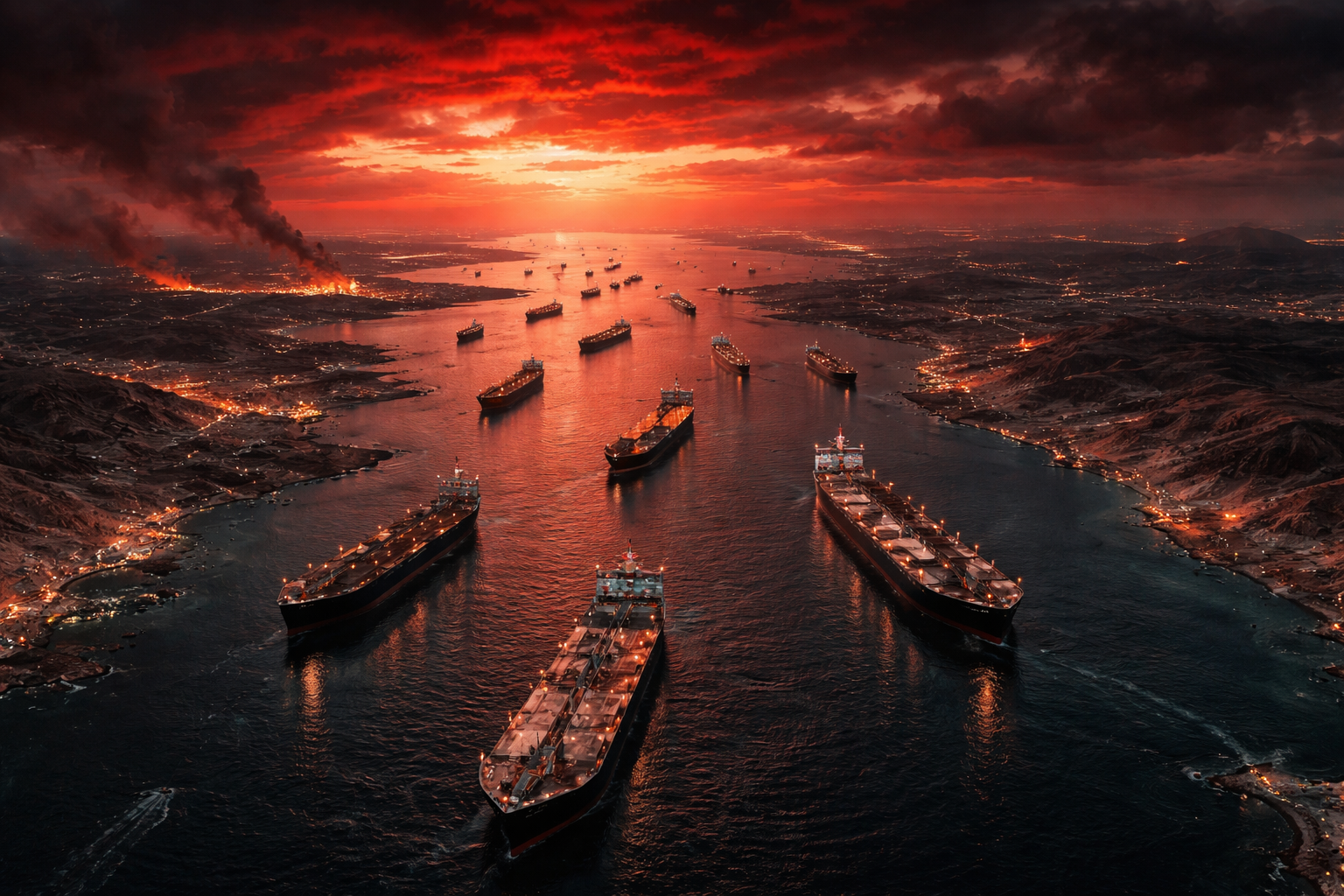
The Bab el-Mandab and the Strait of Hormuz are not neighbours, but they are sequential chokepoints on the same energy artery. If Hormuz is hit, oil struggles to leave the Gulf. If Bab el-Mandab is blocked, it struggles to reach Europe. If both are hit, the entire route breaks end to end.
Cambridge Middle East specialist Elisabeth Kendall put it bluntly — if both straits face restrictions simultaneously, the result would be a “nightmare scenario” that could “disrupt, if not cripple, trade toward Europe.”
That is the knife’s edge the world is currently balancing on.
How Much Oil and Trade Actually Flows Through Bab el-Mandab?
The numbers are staggering.
In the first half of 2025, about 4.2 million barrels per day of crude oil and petroleum products transited the Bab el-Mandab Strait. That represents roughly 10% of global oil shipments, along with LNG and petroleum products — making it a direct parallel to the Strait of Hormuz in terms of energy significance.
Any disruption could halt traffic between Europe and Asia, forcing vessels to detour around Africa and significantly increasing transit times and costs. Its strategic importance has drawn military bases from global powers, including the US, France, and China.
But it is not just about oil.
The strait handles up to 12% of global maritime trade, making it a major artery for trade between Europe and Asia since the opening of the Suez Canal in 1869.
Electronics. Machinery. Consumer goods. Medicines. All of it flows through this narrow 26-kilometre gap. Even a partial disruption would send shockwaves through global supply chains almost immediately.
Even the Fear of Disruption Is Already Causing Damage
Here is something critical to understand: ships don’t have to actually be attacked for the damage to begin.
By increasing the perceived risk to shipping, the Houthis made the Red Sea route commercially unattractive during their earlier campaign. Insurance premiums surged, transit times lengthened, and global freight costs rose sharply.
Shipping companies are risk-averse by nature. The moment credible threats emerge, rerouting begins — even on rumour alone. Cargo gets delayed. Costs go up. Those costs are eventually passed on to consumers worldwide.
Analysts at Macquarie are now warning of a 40% chance that oil could hit $200 a barrel by June — a price level that has never been reached in history.
That is the kind of number that reshapes economies and triggers recessions.
What Happens to Global Trade If the Bab el-Mandab Is Blocked?
If the Bab el-Mandab faces serious disruption, here is what happens next:
- Oil prices spike as supply routes are severed across two critical chokepoints
- LNG supplies to Europe — already stressed — face further cuts
- Container shipping is rerouted around Africa’s Cape of Good Hope, adding 10–14 days and massive costs to every voyage
- Electronics, machinery, and consumer goods face severe delays
- Inflation rises globally as freight and fuel costs filter through supply chains
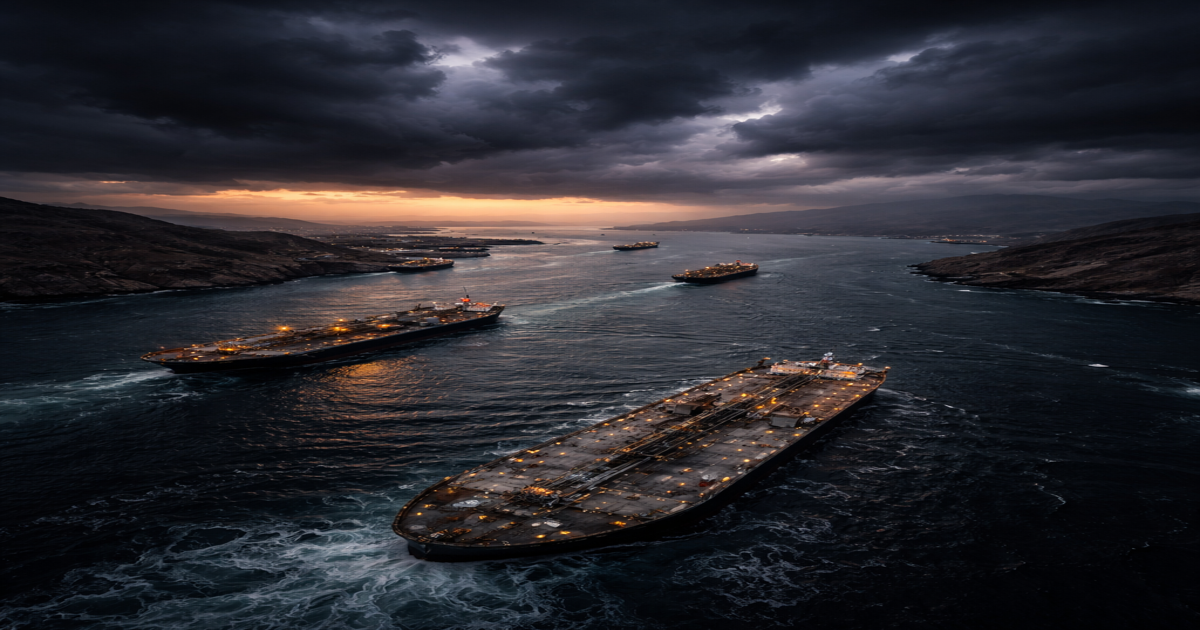
Blockage or serious disruption of the strait forces tankers onto the much longer Cape of Good Hope route, adding 10–14 days of transit, extra fuel, and higher insurance costs — quickly driving up global prices and disrupting supply chains far beyond the region.
The Bigger Picture: One War, Two Straits
What is unfolding in the Middle East right now is not just a regional conflict. It is a potential restructuring of global trade routes.
The Strait of Hormuz was the first domino. The Bab el-Mandab could be the second.
Iran’s strategy appears clear: use its network of proxies and its geographic leverage to apply maximum pressure on the global economy — forcing the US and its allies to deal with an energy and trade crisis at home while fighting a war abroad.
Paralysis of the Bab el-Mandab would escalate pressure on the global economy, make US efforts to resupply its forces more difficult, and force the Pentagon to divert assets away from Iran.
The “Gate of Tears” has been a part of history for centuries. Right now, in March 2026, it may be on the verge of writing a new chapter — one with consequences for every country on the planet.