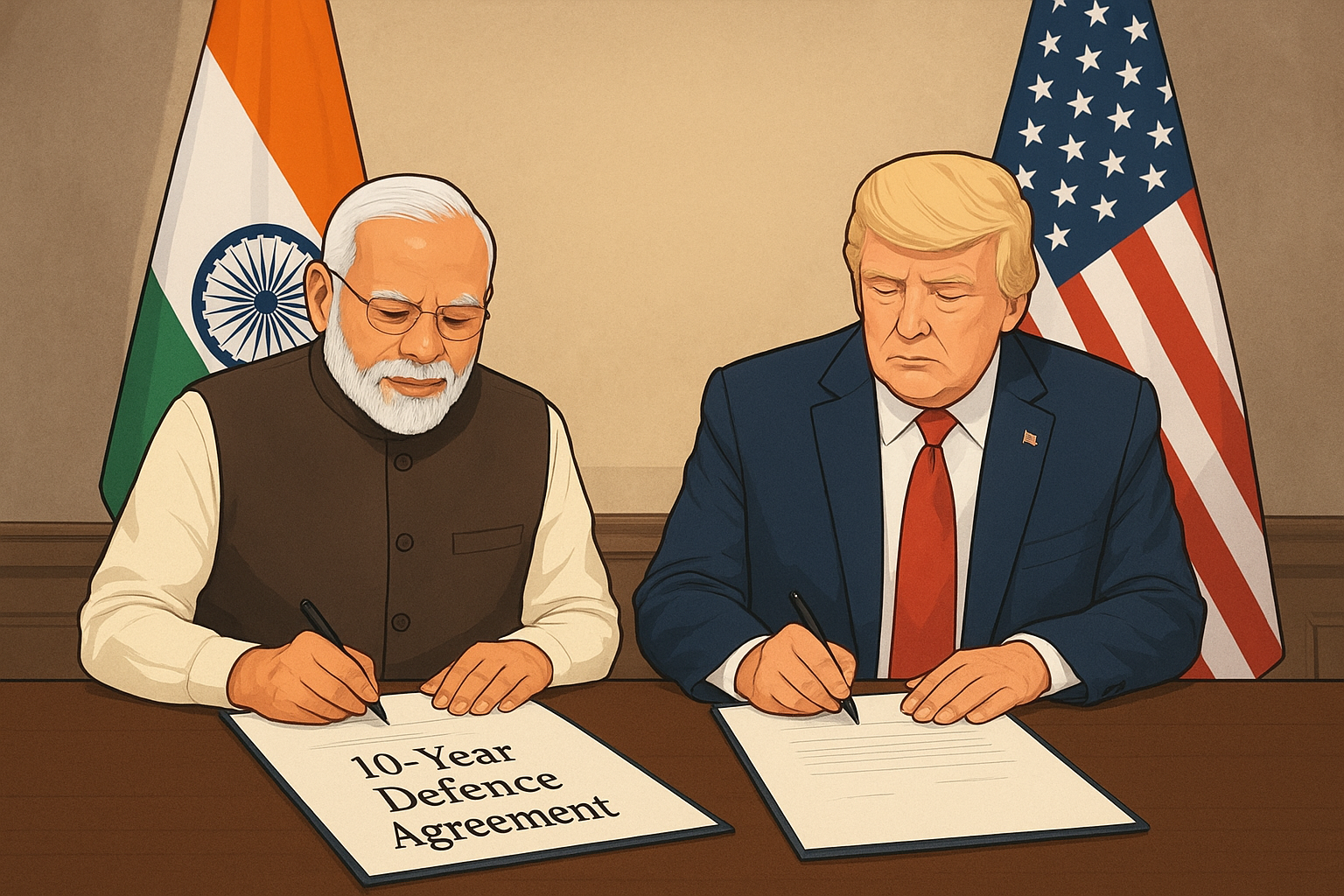
 In a significant move to strengthen bilateral military ties, India and the United States have signed a 10-year defence agreement, marking a new milestone in their strategic partnership. The pact focuses on enhancing operational interoperability, expanding joint exercises, and boosting defence industrial collaboration between the two nations.
This long-term agreement comes at a time when global geopolitical dynamics are shifting rapidly, and both India and the US seek to reinforce their presence in the Indo-Pacific region.
Background: Strengthening Defence Ties Amid Global Tensions
India and the United States have shared a complex defence relationship for decades. While the partnership has deepened over the years, certain periods — especially under former US President Donald Trump’s administration — witnessed moments of strain and uncertainty.
Despite these tensions, the two nations continued to recognize each other’s strategic importance. The signing of this new 10-year defence pact is a strong signal that both countries are committed to moving forward with mutual trust and cooperation.
This agreement reaffirms their shared vision for a free, open, and secure Indo-Pacific, countering growing regional challenges, particularly from China’s assertive military posture.
What the 10-Year Defence Agreement Includes
The newly signed agreement is not just symbolic — it brings real, actionable commitments. Let’s break down its main components:
1. Enhancing Operational Interoperability
One of the key goals of the pact is to improve operational interoperability between the Indian and US armed forces. This means smoother coordination, better communication, and more efficient joint operations.
Under the new agreement, both sides will streamline their defence communication systems and logistics networks, enabling faster responses during joint missions, humanitarian operations, or potential regional conflicts.
2. Expanding Joint Military Exercises
The Malabar Naval Exercise and Cope India Air Exercise have long served as symbols of India-US defence cooperation. With this agreement, both exercises will now see expanded participation, involving more personnel, assets, and coordinated drills.
These exercises will not only boost combat readiness but also foster stronger trust between soldiers, sailors, and airmen from both nations. Increased interaction will ensure smoother collaboration in real-world scenarios, enhancing the overall security framework in the Indo-Pacific region.
3. Boosting Defence Industrial Cooperation
A major highlight of the 10-year defence pact is the renewed focus on defence industrial cooperation. Both countries have agreed to co-develop and co-produce advanced defence technologies and equipment.
This includes:
-
Technology transfer to promote self-reliance in India’s defence sector.
-
Joint research and development (R&D) projects for next-generation systems.
-
Production partnerships between US defence firms and Indian manufacturers.
This aligns with India’s “Make in India” and “Atmanirbhar Bharat” (self-reliant India) initiatives, empowering local industries while giving the US a reliable defence production partner in Asia.
4. Streamlining Logistics and Communication
Efficient logistics and secure communication channels are vital for military cooperation. The agreement outlines measures to simplify defence logistics sharing, ensuring that both nations’ forces can access each other’s facilities for refueling, maintenance, and support during joint missions.
Additionally, secure communication frameworks will be enhanced, allowing real-time information sharing between Indian and US forces. This will significantly improve coordination during exercises, counter-terrorism operations, and regional security missions.
Strategic Significance: Beyond Defence
While the agreement primarily focuses on defence cooperation, its implications extend far beyond the military domain.
1. Strengthening Regional Security
The Indo-Pacific region has become a hotspot for strategic competition. With China’s growing naval presence and territorial assertiveness, India and the US are keen to ensure freedom of navigation and regional stability.
This defence pact strengthens the Quad alliance (India, US, Japan, Australia) and sends a clear message about the commitment to maintaining balance and peace in the region.
2. Enhancing India’s Global Position
For India, this agreement boosts its position as a major defence partner of the United States. It provides access to advanced technologies and military systems that can enhance its national security and modernize its armed forces.
It also helps India diversify its defence partnerships beyond traditional allies like Russia, reducing dependency and increasing strategic flexibility.
3. Economic and Industrial Impact
Joint production and technology transfer will bring significant benefits to India’s defence manufacturing ecosystem. Increased foreign investment, job creation, and skill development are expected as US companies collaborate with Indian firms.
This could transform India into a global defence manufacturing hub, supporting both domestic needs and international exports.
Addressing the Questions: What Does the Agreement Really Mean?
While the agreement brings optimism, experts and analysts have raised important questions about its long-term objectives and implications.
-
Is the deal primarily aimed at countering China?
Many observers see it as a strategic move to balance China’s growing military influence in the Indo-Pacific. -
Will it limit India’s strategic autonomy?
India has historically maintained a non-aligned approach in global politics. Some analysts caution that deeper integration with the US military could narrow India’s room for independent decision-making. -
How sustainable is the cooperation?
With political shifts in both countries, especially during election years, the consistency of defence policies will be key to sustaining long-term trust.
The Road Ahead: A Partnership for the Future
Despite the questions, the 10-year defence agreement between India and the US stands as a landmark moment in global strategic relations.
It marks a transition from transactional cooperation to a comprehensive defence partnership built on shared values and interests. Both nations now aim to build a framework that is not just military but also technological, industrial, and diplomatic.
As the world enters a new era of security challenges, this partnership is expected to play a crucial role in shaping the Indo-Pacific landscape.
Conclusion
The signing of the India-US 10-year defence agreement signals more than just a policy move — it represents a commitment to shared security, innovation, and strategic balance in an uncertain world.
With expanded joint exercises, technology collaboration, and deeper military integration, the pact is set to redefine defence cooperation between two of the world’s largest democracies.
Both nations now stand ready to write the next chapter in their partnership — one that promises peace, strength, and mutual growth.