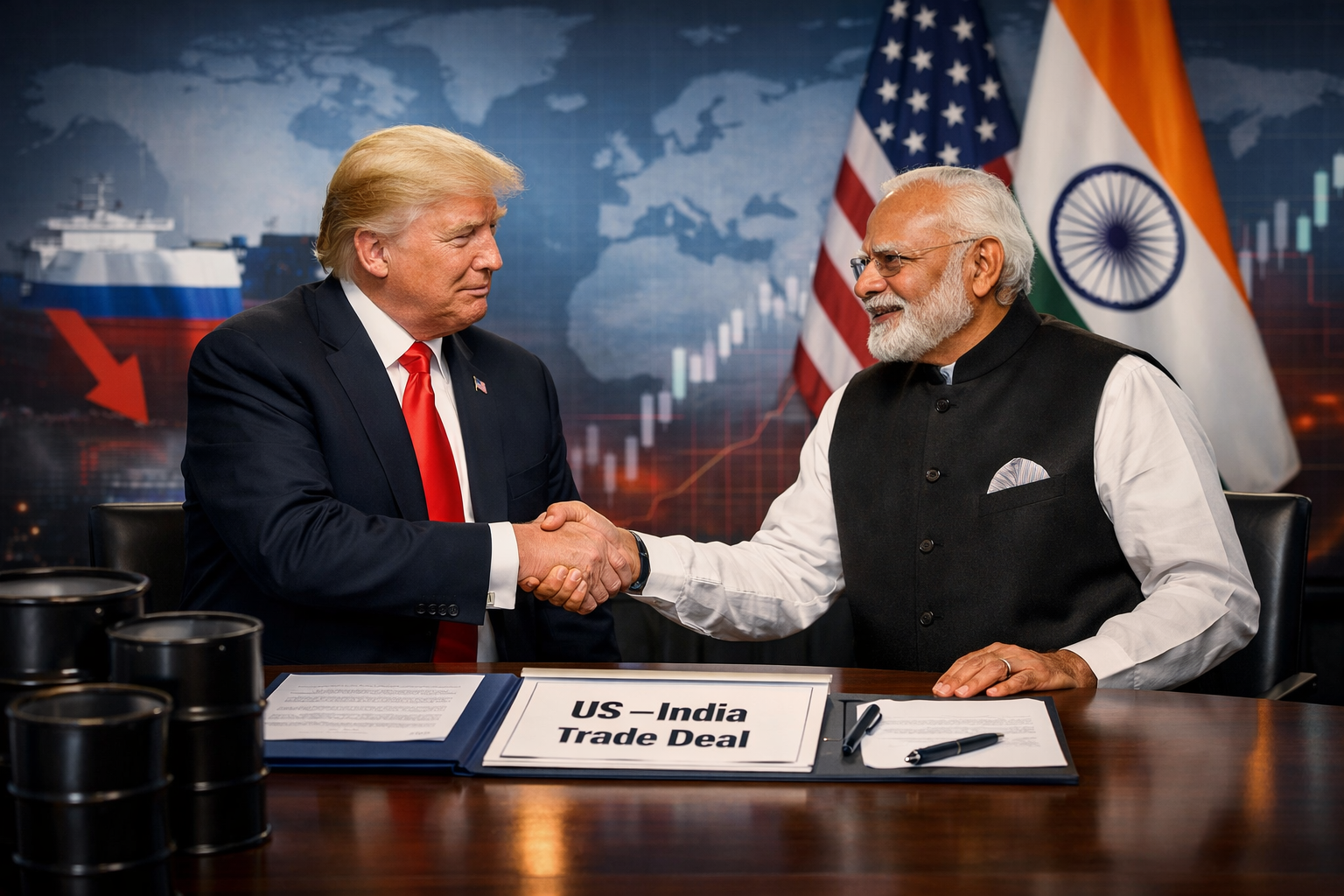
 The latest trade deal between India and the United States has created global headlines.
Former U.S. President Donald Trump recently claimed that India may stop importing oil from Russia as part of its new trade understanding with America.
This statement has sparked debate across political, economic, and energy sectors.
Many experts are now asking one big question: Will India really cut Russian oil imports to strengthen trade ties with the U.S.?
The issue is not just about trade.
It also connects to geopolitics, energy security, and the ongoing Russia-Ukraine war.
Let’s break it down in simple terms.
What Is the India-US Trade Deal?
India and the United States recently agreed to deepen economic cooperation.
The goal is simple: increase trade, reduce tariffs, and strengthen strategic ties.
According to Trump, India will offer zero tariffs on American goods.
If true, this would make U.S. products cheaper and more competitive in the Indian market.
However, many analysts say the deal’s terms are still unclear.
There are no detailed documents publicly explaining how each sector will be affected.
This lack of clarity has raised concerns.
Zero Tariffs: Promise or Political Claim?
Trump strongly claimed that India would impose zero tariffs on U.S. goods.
But experts question whether this is realistic.
India has traditionally protected sensitive industries like:
-
Agriculture
-
Dairy
-
Small farmers
-
Local manufacturing
Removing tariffs completely could hurt domestic producers.
For example, cheap American dairy products might damage Indian dairy cooperatives.
Similarly, U.S. farm goods could impact Indian farmers’ income.
Because of this, many economists believe full zero tariffs are unlikely.
Instead, there may be selective reductions.
So far, India has not officially confirmed Trump’s statement.
$500 Billion Purchase Commitment
One of the biggest highlights of the deal is India’s commitment to buy $500 billion worth of American goods.
This number is massive.
It includes:
-
Defense equipment
-
Technology
-
Energy supplies
-
Aircraft
-
Industrial goods
-
Critical minerals
Such a large purchase would significantly boost U.S. exports.
At the same time, it could reduce India’s dependence on other countries.
Especially Russia.
This is where the oil issue becomes important.
Why Russia Oil Matters to India
India is one of the world’s largest oil importers.
It buys crude oil from many countries to meet energy demand.
After the Ukraine war began, Russia started offering oil at heavy discounts.
India took advantage of this.
Cheap Russian oil helped:
-
Lower fuel costs
-
Control inflation
-
Protect the economy
-
Save billions in import bills
Today, Russia is one of India’s top oil suppliers.
Stopping these imports would not be an easy decision.
US Pressure on India
The United States has been pressuring countries to reduce trade with Russia.
The reason is simple.
Oil money funds Russia’s military operations in Ukraine.
If countries stop buying Russian oil, Moscow loses revenue.
This weakens its war capabilities.
That is why Washington wants India to cut or limit imports.
Trump claims the new trade deal will push India in that direction.
In return, the U.S. may offer better trade access and economic benefits.
This creates a strategic bargain.
Will India Really Stop Russian Oil?
This is the key question.
The answer is complicated.
India follows a policy of strategic independence.
It does not fully align with any one country.
Instead, it balances relations with:
-
The U.S.
-
Russia
-
Europe
-
Middle East
Completely stopping Russian oil may hurt India’s energy security.
Prices could rise.
Inflation could increase.
Economic growth might slow.
So experts believe India may not fully stop imports.
Instead, it might:
-
Gradually reduce purchases
-
Diversify suppliers
-
Increase U.S. energy imports
-
Maintain limited Russian trade
This would help balance both sides.
Impact on Critical Minerals
The trade deal also involves critical minerals.
These are essential for:
-
Electronics
-
EV batteries
-
Defense technology
-
Renewable energy
Russia supplies some important resources.
If India shifts purchases toward the U.S., Russia could lose another revenue stream.
This again fits into the broader Western strategy to isolate Moscow economically.
But replacing suppliers takes time.
Infrastructure and logistics must also change.
So any transition will likely be slow.
Double Standards in Global Policy
Another major discussion point is double standards.
The U.S. wants India to stop trading with Russia.
But critics point out something important.
China continues large-scale trade with Russia.
Yet, Washington focuses more pressure on India.
This raises questions about fairness.
Some experts say sanctions only work if everyone follows them equally.
If major economies keep buying Russian oil, sanctions lose impact.
This makes the situation more complex.
India argues it must prioritize national interest over foreign pressure.
How This Affects India’s Economy
If India reduces Russian oil imports, several effects may follow.
Possible benefits:
-
Stronger ties with the U.S.
-
Better trade deals
-
More foreign investment
-
Technology partnerships
Possible risks:
-
Higher fuel prices
-
Increased inflation
-
Higher import bills
-
Pressure on consumers
So policymakers must carefully balance both sides.
Economic stability remains the top priority.
Political Significance of Trump’s Statement
It is also important to remember the political angle.
Trump is known for bold claims.
His statements may be strategic or exaggerated.
Sometimes leaders announce big numbers to show strength.
Until official agreements are published, many details remain uncertain.
So investors and businesses should wait for confirmation.
Facts matter more than headlines.
What Experts Are Saying
Economists believe:
-
India will not fully stop Russian oil overnight
-
Trade deals take years to implement
-
Negotiations are still ongoing
-
Gradual change is more likely
Energy analysts say diversification is smarter than sudden cuts.
India may buy more oil from:
-
USA
-
Middle East
-
Africa
But Russia may still remain part of the mix.
The Bigger Geopolitical Picture
This issue goes beyond trade.
It reflects changing global power dynamics.
India is becoming a major global player.
Both the U.S. and Russia want strong ties with New Delhi.
That gives India bargaining power.
Instead of choosing sides, India may use this position to secure better deals from both.
This strategy has worked well in the past.
Conclusion
Trump’s claim that India will stop importing Russian oil after the U.S. trade deal has created global attention.
However, the reality is more complex.
The trade deal includes:
-
Zero tariff discussions
-
$500 billion purchase commitments
-
Pressure to reduce Russian trade
-
Strategic energy decisions
India must protect its economy while strengthening global partnerships.
Completely cutting Russian oil seems unlikely in the short term.
A gradual reduction is more realistic.
In the end, India will choose what benefits its national interest the most.
The coming months will reveal how this deal truly unfolds.
For now, one thing is clear.
India’s energy choices will shape not just trade relations, but global geopolitics too.